


UPDATED [Mar 21, 2026] Pass Databricks Certified Data Engineer Associate Exam Exam with Latest Questions
Databricks-Certified-Data-Engineer-Associate Exam Practice Questions prepared by Databricks Professionals
Databricks Certified Data Engineer Associate exam consists of 60 multiple-choice questions that must be completed within 90 minutes. Candidates are required to score at least 70% to pass the exam. Databricks-Certified-Data-Engineer-Associate exam is administered online through the GAQM testing platform, which allows candidates to take the exam from anywhere in the world.
The GAQM Databricks-Certified-Data-Engineer-Associate (Databricks Certified Data Engineer Associate) Exam is a comprehensive certification program designed to validate the skills and knowledge of data engineers in using Databricks to build and manage data pipelines, perform data analysis, and develop data-driven solutions. Databricks-Certified-Data-Engineer-Associate exam is designed for professionals who work with big data and are responsible for designing, building, and maintaining data pipelines using Databricks.
NEW QUESTION # 81
A data engineer has realized that the data files associated with a Delta table are incredibly small. They want to compact the small files to form larger files to improve performance.
Which of the following keywords can be used to compact the small files?
- A. REPARTITION
- B. REDUCE
- C. VACUUM
- D. COMPACTION
- E. OPTIMIZE
Answer: E
Explanation:
The keyword that can be used to compact the small files associated with a Delta table is OPTIMIZE. The OPTIMIZE command performs file compaction on a Delta table by rewriting a set of small files into a set of larger files1. This can improve the performance of queries that scan the table by reducing the number of files that need to be read and the amount of metadata that needs to be processed1. The OPTIMIZE command can also optionally sort the data within each file by a given set of columns, which can further improve the query performance by enabling data skipping and predicate pushdown1. The OPTIMIZE command can be applied to the whole table or to a specific partition of the table1.
The other keywords are not suitable for compacting the small files associated with a Delta table. REDUCE is a keyword used in the SQL syntax for aggregating data using a user-defined function2. COMPACTION is not a valid keyword in SQL or Python. REPARTITION is a keyword used in the Python syntax for changing the number of partitions of a DataFrame or an RDD3. VACUUM is a keyword used to remove files that are no longer referenced by a Delta table and are older than a retention threshold4.
References:
* 1: OPTIMIZE | Databricks on AWS
* 2: REDUCE | Databricks on AWS
* 3: repartition | Databricks on AWS
* 4: VACUUM | Databricks on AWS
NEW QUESTION # 82
Which of the following describes the relationship between Gold tables and Silver tables?
- A. Gold tables are more likely to contain more data than Silver tables.
- B. Gold tables are more likely to contain a less refined view of data than Silver tables.
- C. Gold tables are more likely to contain truthful data than Silver tables.
- D. Gold tables are more likely to contain valuable data than Silver tables.
- E. Gold tables are more likely to contain aggregations than Silver tables.
Answer: E
Explanation:
According to the medallion lakehouse architecture, gold tables are the final layer of data that powers analytics, machine learning, and production applications. They are often highly refined and aggregated, containing data that has been transformed into knowledge, rather than just information. Silver tables, on the other hand, are the intermediate layer of data that represents a validated, enriched version of the raw data from the bronze layer.
They provide an enterprise view of all its key business entities, concepts and transactions, but they may not have all the aggregations and calculations that are required for specific use cases. Therefore, gold tables are more likely to contain aggregations than silver tables. References:
* What is the medallion lakehouse architecture?
* What is a Medallion Architecture?
NEW QUESTION # 83
A data architect has determined that a table of the following format is necessary:
Which of the following code blocks uses SQL DDL commands to create an empty Delta table in the above format regardless of whether a table already exists with this name?
- A. Option D
- B. Option E
- C. Option B
- D. Option C
- E. Option A
Answer: B
NEW QUESTION # 84
A data engineer is running code in a Databricks Repo that is cloned from a central Git repository. A colleague of the data engineer informs them that changes have been made and synced to the central Git repository. The data engineer now needs to sync their Databricks Repo to get the changes from the central Git repository.
Which of the following Git operations does the data engineer need to run to accomplish this task?
- A. Clone
- B. Commit
- C. Pull
- D. Push
- E. Merge
Answer: C
Explanation:
To sync a Databricks Repo with the changes from a central Git repository, the data engineer needs to run the Git pull operation. This operation fetches the latest updates from the remote repository and merges them with the local repository. The data engineer can use the Pull button in the Databricks Repos UI, or use the git pull command in a terminal session. The other options are not relevant for this task, as they either push changes to the remote repository (Push), combine two branches (Merge), save changes to the local repository (Commit), or create a new local repository from a remote one (Clone). Reference:
Run Git operations on Databricks Repos
Git pull
NEW QUESTION # 85
A data engineer needs to create a table in Databricks using data from their organization's existing SQLite database.
They run the following command:
Which of the following lines of code fills in the above blank to successfully complete the task?
- A. org.apache.spark.sql.jdbc
- B. org.apache.spark.sql.sqlite
- C. autoloader
- D. sqlite
- E. DELTA
Answer: D
Explanation:
1: In the given command, a data engineer is trying to create a table in Databricks using data from an SQLite database. The correct option to fill in the blank is "sqlite" because it specifies the type of database being connected to in a JDBC connection string. The USING clause should be followed by the format of the data, and since we are connecting to an SQLite database, "sqlite" would be appropriate here. Reference:
Create a table using JDBC
JDBC connection string
SQLite JDBC driver
NEW QUESTION # 86
A data engineer has realized that they made a mistake when making a daily update to a table. They need to use Delta time travel to restore the table to a version that is 3 days old. However, when the data engineer attempts to time travel to the older version, they are unable to restore the data because the data files have been deleted.
Which of the following explains why the data files are no longer present?
- A. The VACUUM command was run on the table
- B. The DELETE HISTORY command was run on the table
- C. The TIME TRAVEL command was run on the table
- D. The HISTORY command was run on the table
- E. The OPTIMIZE command was nun on the table
Answer: A
Explanation:
The VACUUM command is used to remove files that are no longer referenced by a Delta table and are older than the retention threshold1. The default retention period is 7 days2, but it can be changed by setting the delta.logRetentionDuration and delta.deletedFileRetentionDuration configurations3. If the VACUUM command was run on the table with a retention period shorter than 3 days, then the data files that were needed to restore the table to a 3-day-old version would have been deleted. The other commands do not delete data files from the table. The TIME TRAVEL command is used to query a historical version of the table4. The DELETE HISTORY command is not a valid command in Delta Lake. The OPTIMIZE command is used to improve the performance of the table by compacting small files into larger ones5. The HISTORY command is used to retrieve information about the operations performed on the table. References: 1: VACUUM | Databricks on AWS 2: Work with Delta Lake table history | Databricks on AWS 3: [Delta Lake configuration | Databricks on AWS] 4: Work with Delta Lake table history - Azure Databricks 5: [OPTIMIZE | Databricks on AWS] : [HISTORY | Databricks on AWS]
NEW QUESTION # 87
A data engineer has a Job with multiple tasks that runs nightly. Each of the tasks runs slowly because the clusters take a long time to start.
Which of the following actions can the data engineer perform to improve the start up time for the clusters used for the Job?
- A. They can use endpoints available in Databricks SQL
- B. They can use jobs clusters instead of all-purpose clusters
- C. They can configure the clusters to autoscale for larger data sizes
- D. They can use clusters that are from a cluster pool
- E. They can configure the clusters to be single-node
Answer: D
Explanation:
Explanation
Cluster pools are a way to pre-provision clusters that are ready to use. This can reduce the start up time for clusters, as they do not have to be created from scratch. All-purpose clusters are not pre-provisioned, so they will take longer to start up. Jobs clusters are a type of cluster pool, but they are not the best option for this use case. Jobs clusters are designed for long-running jobs, and they can be more expensive than other types of cluster pools. Single-node clusters are the smallest type of cluster, and they will start up the fastest. However, they may not be powerful enough to run the Job's tasks. Autoscaling clusters can scale up or down based on demand. This can help to improve the start up time for clusters, as they will only be created when they are needed. However, autoscaling clusters can also be more expensive than other types of cluster pool
https://docs.databricks.com/en/clusters/pool-best-practices.html
NEW QUESTION # 88
A data engineer needs to apply custom logic to string column city in table stores for a specific use case. In order to apply this custom logic at scale, the data engineer wants to create a SQL user-defined function (UDF).
Which of the following code blocks creates this SQL UDF?
- A.

- B.

- C.

- D.

- E.

Answer: B
Explanation:
https://www.databricks.com/blog/2021/10/20/introducing-sql-user-defined-functions.html
NEW QUESTION # 89
A data engineer is setting up access control in Unity Catalog and needs to ensure that a group of data analysts can query tables but not modify data.
Which permission should the data engineer grant to the data analysts?
- A. SELECT
- B. MODIFY
- C. ALL PRIVILEGES
- D. INSERT
Answer: A
NEW QUESTION # 90
A data engineer needs to create a table in Databricks using data from their organization's existing SQLite database.
They run the following command: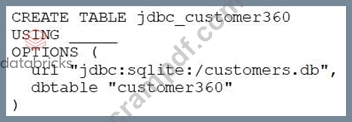
Which of the following lines of code fills in the above blank to successfully complete the task?
- A. org.apache.spark.sql.jdbc
- B. org.apache.spark.sql.sqlite
- C. autoloader
- D. sqlite
- E. DELTA
Answer: D
Explanation:
In the given command, a data engineer is trying to create a table in Databricks using data from an SQLite database. The correct option to fill in the blank is "sqlite" because it specifies the type of database being connected to in a JDBC connection string. The USING clause should be followed by the format of the data, and since we are connecting to an SQLite database, "sqlite" would be appropriate here. References:
* Create a table using JDBC
* JDBC connection string
* SQLite JDBC driver
NEW QUESTION # 91
A data engineer has a Job with multiple tasks that runs nightly. Each of the tasks runs slowly because the clusters take a long time to start.
Which of the following actions can the data engineer perform to improve the start up time for the clusters used for the Job?
- A. They can use endpoints available in Databricks SQL
- B. They can use jobs clusters instead of all-purpose clusters
- C. They can configure the clusters to autoscale for larger data sizes
- D. They can use clusters that are from a cluster pool
- E. They can configure the clusters to be single-node
Answer: D
Explanation:
The best action that the data engineer can perform to improve the start up time for the clusters used for the Job is to use clusters that are from a cluster pool. A cluster pool is a set of idle clusters that can be used by jobs or interactive sessions. By using a cluster pool, the data engineer can avoid the cluster creation time and reduce the latency of the tasks. Cluster pools also offer cost savings and resource efficiency, as they can be shared by multiple users and jobs.
Option A is not relevant, as endpoints available in Databricks SQL are used for creating and managing SQL analytics workloads, not for improving cluster start up time.
Option B is not correct, as jobs clusters and all-purpose clusters have similar start up times. Jobs clusters are clusters that are dedicated to run a single job and are terminated when the job is completed. All-purpose clusters are clusters that can be used for multiple purposes, such as interactive sessions, notebooks, or multiple jobs. Both types of clusters can benefit from using a cluster pool.
Option C is not advisable, as configuring the clusters to be single-node will reduce the parallelism and performance of the tasks. Single-node clusters are clusters that have only one worker node and are typically used for testing or development purposes. They are not suitable for running production jobs that require high scalability and fault tolerance.
Option E is not helpful, as configuring the clusters to autoscale for larger data sizes will not affect the start up time of the clusters. Autoscaling is a feature that allows clusters to dynamically adjust the number of worker nodes based on the workload. It can help optimize the resource utilization and cost efficiency of the clusters, but it does not speed up the cluster creation process.
:
Cluster Pools
Jobs
Clusters
[Databricks Data Engineer Professional Exam Guide]
NEW QUESTION # 92
A new data engineering team team. has been assigned to an ELT project. The new data engineering team will need full privileges on the database customers to fully manage the project.
Which of the following commands can be used to grant full permissions on the database to the new data engineering team?
- A. GRANT ALL PRIVILEGES ON DATABASE customers TO team;
- B. GRANT USAGE ON DATABASE customers TO team;
- C. GRANT ALL PRIVILEGES ON DATABASE team TO customers;
- D. GRANT SELECT PRIVILEGES ON DATABASE customers TO teams;
- E. GRANT SELECT CREATE MODIFY USAGE PRIVILEGES ON DATABASE customers TO team;
Answer: A
Explanation:
To grant full permissions on a database to a user, group, or service principal, the GRANT ALL PRIVILEGES ON DATABASE command can be used. This command grants all the applicable privileges on the database, such as CREATE, SELECT, MODIFY, and USAGE. The other options are either incorrect or incomplete, as they do not grant all the privileges or specify the wrong database or principal. Reference:
GRANT
Privileges
NEW QUESTION # 93
A data engineer wants to schedule their Databricks SQL dashboard to refresh every hour, but they only want the associated SQL endpoint to be running when It is necessary. The dashboard has multiple queries on multiple datasets associated with it. The data that feeds the dashboard is automatically processed using a Databricks Job.
Which approach can the data engineer use to minimize the total running time of the SQL endpoint used in the refresh schedule of their dashboard?
- A. 0 They can ensure the dashboard's SQL endpoint matches each of the queries' SQL endpoints.
- B. O They can set up the dashboard's SQL endpoint to be serverless.
- C. Q They can turn on the Auto Stop feature for the SQL endpoint.
- D. O They can reduce the cluster size of the SQL endpoint.
Answer: C
Explanation:
To minimize the total running time of the SQL endpoint used in the refresh schedule of a dashboard in Databricks, the most effective approach is to utilize the Auto Stop feature. This feature allows the SQL endpoint to automatically stop after a period of inactivity, ensuring that it only runs when necessary, such as during the dashboard refresh or when actively queried. This minimizes resource usage and associated costs by ensuring the SQL endpoint is not running idle outside of these operations.
Reference:
Databricks documentation on SQL endpoints: SQL Endpoints in Databricks
NEW QUESTION # 94
A global retail company sells products across multiple categories (e.g.. Electronics, Clothing) and regions (e.
g.. North. South, East. West). The sales team has provided the data engineer with a PySpark dataframe named sales_df as below and the team wants the data engineer to analyze the sales data to help them make strategic decisions.
- A. Category_sales = sales_df.groupBy("reqion"). agq(sum("sales_amountn).alias(ntotal_sales_amount''))
- B. Category_sales = sales df.groupBy("category").agg(sum("sales amount") .alias ("total sales amount"))
- C. Category_sales = sales_df.sum("3ales_amount"). g-1- upBy("categcryn).alias("toLal_sales_amount))
- D. Category_sale: .es df -agg (sum ("sales amount") .-;r*i:rRy ("category") .alias ("total sa.en amount"))
Answer: B
NEW QUESTION # 95
A data engineer has a Python notebook in Databricks, but they need to use SQL to accomplish a specific task within a cell. They still want all of the other cells to use Python without making any changes to those cells.
Which of the following describes how the data engineer can use SQL within a cell of their Python notebook?
- A. They can change the default language of the notebook to SQL
- B. They can add %sql to the first line of the cell
- C. It is not possible to use SQL in a Python notebook
- D. They can attach the cell to a SQL endpoint rather than a Databricks cluster
- E. They can simply write SQL syntax in the cell
Answer: B
NEW QUESTION # 96
In order for Structured Streaming to reliably track the exact progress of the processing so that it can handle any kind of failure by restarting and/or reprocessing, which of the following two approaches is used by Spark to record the offset range of the data being processed in each trigger?
- A. Replayable Sources and Idempotent Sinks
- B. Write-ahead Logs and Idempotent Sinks
- C. Checkpointing and Write-ahead Logs
- D. Structured Streaming cannot record the offset range of the data being processed in each trigger.
- E. Checkpointing and Idempotent Sinks
Answer: C
Explanation:
Structured Streaming uses checkpointing and write-ahead logs to record the offset range of the data being processed in each trigger. This ensures that the engine can reliably track the exact progress of the processing and handle any kind of failure by restarting and/or reprocessing. Checkpointing is the mechanism of saving the state of a streaming query to fault-tolerant storage (such as HDFS) so that it can be recovered after a failure. Write-ahead logs are files that record the offset range of the data being processed in each trigger and are written to the checkpoint location before the processing starts. These logs are used to recover the query state and resume processing from the last processed offset range in case of a failure. Reference: Structured Streaming Programming Guide, Fault Tolerance Semantics
NEW QUESTION # 97
Which of the following must be specified when creating a new Delta Live Tables pipeline?
- A. A path to cloud storage location for the written data
- B. A location of a target database for the written data
- C. At least one notebook library to be executed
- D. The preferred DBU/hour cost
- E. A key-value pair configuration
Answer: C
Explanation:
Explanation
https://docs.databricks.com/en/delta-live-tables/tutorial-pipelines.html
NEW QUESTION # 98
A data engineer has developed a data pipeline to ingest data from a JSON source using Auto Loader, but the engineer has not provided any type inference or schema hints in their pipeline. Upon reviewing the data, the data engineer has noticed that all of the columns in the target table are of the string type despite some of the fields only including float or boolean values.
Which of the following describes why Auto Loader inferred all of the columns to be of the string type?
- A. Auto Loader cannot infer the schema of ingested data
- B. Auto Loader only works with string data
- C. There was a type mismatch between the specific schema and the inferred schema
- D. All of the fields had at least one null value
- E. JSON data is a text-based format
Answer: E
Explanation:
Explanation
JSON data is a text-based format that uses strings to represent all values. When Auto Loader infers the schema of JSON data, it assumes that all values are strings. This is because Auto Loader cannot determine the type of a value based on its string representation. https://docs.databricks.com/en/ingestion/auto-loader/schema.html Forexample, the following JSON string represents a value that is logically a boolean: JSON "true" Use code with caution. Learn more However, Auto Loader would infer that the type of this value is string. This is because Auto Loader cannot determine that the value is a boolean based on its string representation. In order to get Auto Loader to infer the correct types for columns, the data engineer can provide type inference or schema hints. Type inference hints can be used to specify the types of specific columns. Schema hints can be used to provide the entire schema of the data. Therefore, the correct answer is B. JSON data is a text-based format.
NEW QUESTION # 99
A data engineering project involves processing large batches of data on a daily schedule using ETL. The jobs are resource-intensive and vary in size, requiring a scalable, cost-efficient compute solution that can automatically scale based on the workload.
Which compute approach will satisfy the needs described?
- A. Databricks SQL Serverless
- B. Job Cluster
- C. Dedicated Cluster
- D. All-Purpose Cluster
Answer: B
NEW QUESTION # 100
A data engineer has been provided a PySpark DataFrame named df with columns product and revenue. The data engineer needs to compute complex aggregations to determine each product's total revenue, average revenue, and transaction count.
Which code snippet should the data engineer use?
- A.

- B.

- C.

- D.

Answer: D
NEW QUESTION # 101
Which of the following is stored in the Databricks customer's cloud account?
- A. Notebooks
- B. Databricks web application
- C. Repos
- D. Cluster management metadata
- E. Data
Answer: E
Explanation:
The only option that is stored in the Databricks customer's cloud account is data. Data is stored in the customer's cloud storage service, such as AWS S3 or Azure Data Lake Storage. The customer has full control and ownership of their data and can access it directly from their cloud account.
Option A is not correct, as the Databricks web application is hosted and managed by Databricks on their own cloud infrastructure. The customer does not need to install or maintain the web application, but only needs to access it through a web browser.
Option B is not correct, as the cluster management metadata is stored and managed by Databricks on their own cloud infrastructure. The cluster management metadata includes information such as cluster configuration, status, logs, and metrics. The customer can view and manage their clusters through the Databricks web application, but does not have direct access to the cluster management metadata.
Option C is not correct, as the repos are stored and managed by Databricks on their own cloud infrastructure.
Repos are version-controlled repositories that store code and data files for Databricks projects. The customer can create and manage their repos through the Databricks web application, but does not have direct access to the repos.
Option E is not correct, as the notebooks are stored and managed by Databricks on their own cloud infrastructure. Notebooks are interactive documents that contain code, text, and visualizations for Databricks workflows. The customer can create and manage their notebooks through the Databricks web application, but does not have direct access to the notebooks.
References:
* Databricks Architecture
* Databricks Data Sources
* Databricks Repos
* [Databricks Notebooks]
* [Databricks Data Engineer Professional Exam Guide]
NEW QUESTION # 102
A dataset has been defined using Delta Live Tables and includes an expectations clause:
CONSTRAINT valid_timestamp EXPECT (timestamp > '2020-01-01') ON VIOLATION FAIL UPDATE What is the expected behavior when a batch of data containing data that violates these constraints is processed?
- A. Records that violate the expectation are dropped from the target dataset and recorded as invalid in the event log.
- B. Records that violate the expectation are added to the target dataset and flagged as invalid in a field added to the target dataset.
- C. Records that violate the expectation cause the job to fail.
- D. Records that violate the expectation are added to the target dataset and recorded as invalid in the event log.
- E. Records that violate the expectation are dropped from the target dataset and loaded into a quarantine table.
Answer: C
Explanation:
The expected behavior when a batch of data containing data that violates the expectation is processed is that the job will fail. This is because the expectation clause has the ON VIOLATION FAIL UPDATE option, which means that if any record in the batch does not meet the expectation, the entire batch will be rejected and the job will fail. This option is useful for enforcing strict data quality rules and preventing invalid data from entering the target dataset.
Option A is not correct, as the ON VIOLATION FAIL UPDATE option does not drop the records that violate the expectation, but fails the entire batch. To drop the records that violate the expectation and record them as invalid in the event log, the ON VIOLATION DROP RECORD option should be used.
Option C is not correct, as the ON VIOLATION FAIL UPDATE option does not drop the records that violate the expectation, but fails the entire batch. To drop the records that violate the expectation and load them into a quarantine table, the ON VIOLATION QUARANTINE RECORD option should be used.
Option D is not correct, as the ON VIOLATION FAIL UPDATE option does not add the records that violate the expectation, but fails the entire batch. To add the records that violate the expectation and record them as invalid in the event log, the ON VIOLATION LOG RECORD option should be used.
Option E is not correct, as the ON VIOLATION FAIL UPDATE option does not add the records that violate the expectation, but fails the entire batch. To add the records that violate the expectation and flag them as invalid in a field added to the target dataset, the ON VIOLATION FLAG RECORD option should be used.
References:
* Delta Live Tables Expectations
* [Databricks Data Engineer Professional Exam Guide]
NEW QUESTION # 103
Which of the following describes a benefit of creating an external table from Parquet rather than CSV when using a CREATE TABLE AS SELECT statement?
- A. Parquet files will become Delta tables
- B. CREATE TABLE AS SELECT statements cannot be used on files
- C. Parquet files have the ability to be optimized
- D. Parquet files can be partitioned
- E. Parquet files have a well-defined schema
Answer: E
Explanation:
Option C is the correct answer because Parquet files have a well-defined schema that is embedded within the data itself. This means that the data types and column names of the Parquet files are automatically detected and preserved when creating an external table from them. This also enables the use of SQL and other structured query languages to access and analyze the data. CSV files, on the other hand, do not have a schema embedded in them, and require specifying the schema explicitly or inferring it from the data when creating an external table from them. This can lead to errors or inconsistencies in the data types and column names, and also increase the processing time and complexity.
CREATE TABLE AS SELECT, Parquet Files, CSV Files, Parquet vs. CSV
NEW QUESTION # 104
......
To take the Databricks-Certified-Data-Engineer-Associate exam, individuals must have a good understanding of data engineering concepts and experience working with Databricks. Databricks-Certified-Data-Engineer-Associate exam consists of multiple-choice questions that cover a wide range of topics, including data ingestion, data transformation, data storage, and data analysis. Candidates must score a passing grade to earn the certification.
Databricks-Certified-Data-Engineer-Associate Exam Practice Materials Collection: https://www.crampdf.com/Databricks-Certified-Data-Engineer-Associate-exam-prep-dumps.html
Use Valid New Databricks-Certified-Data-Engineer-Associate Questions - Top choice Help You Gain Success: https://drive.google.com/open?id=1drE2FJ7RwLypniXnIqCEPoeQOl3dKtl3