


NSE7_ADA-6.3 Exam Dumps Free Test Engine Verified By NSE 7 Network Security Architect Certified Experts
Use Real Fortinet Achieve the NSE7_ADA-6.3 Dumps - 100% Exam Passing Guarantee
Fortinet NSE7_ADA-6.3 exam consists of 23 complex scenarios that simulate real-world security threats. Candidates are required to analyze each situation and identify the best solution using Fortinet’s advanced analytics tools. The test duration is six hours, and the passing score is 70%. Fortinet NSE 7 - Advanced Analytics 6.3 certification is valid for two years, after which candidates need to recertify to stay up to date with Fortinet’s latest security solutions.
The NSE7_ADA-6.3 exam is a comprehensive test that evaluates a candidate's understanding of Fortinet's advanced analytics solutions. NSE7_ADA-6.3 exam consists of multiple-choice questions and practical exercises that test a candidate's ability to analyze data, detect security threats, and configure Fortinet solutions to protect against them. Candidates who pass the exam demonstrate their ability to design and implement advanced security solutions that can identify and respond to a wide range of security threats.
To pass the Fortinet NSE7_ADA-6.3 exam, candidates must have a strong understanding of advanced analytics concepts, as well as hands-on experience with tools and technologies used in the field. NSE7_ADA-6.3 exam consists of 60 multiple choice questions to be completed in 120 minutes. A passing score of 60% or higher is required to obtain certification. Upon passing the exam, candidates will receive the Fortinet NSE 7 - Advanced Analytics 6.3 certification, which is recognized globally as a mark of excellence in advanced analytics and cybersecurity.
NEW QUESTION # 21
Which three processes are collector processes? (Choose three.)
- A. phAgentManaqer
- B. phRuleMaster
- C. phMonitorAgent
- D. phParser
- E. phReportM aster
Answer: B,C,D
Explanation:
Explanation
The collector processes are responsible for receiving, parsing, normalizing, correlating, and monitoring events from various sources. The collector processes are phParser, phRuleMaster, and phMonitorAgent.
NEW QUESTION # 22
Which three statements about collector communication with the FortiSIEM cluster are true? (Choose three.)
- A. Collectors upload event data to any node in the worker upload list, but report their health directly to the supervisor node.
- B. Collectors communicate periodically with the supervisor node.
- C. The supervisor periodically checks the health of the collector.
- D. The only communication between the collector and the supervisor is during the registration process.
- E. The supervisor does not initiate any connections to the collector node.
Answer: A,B,C
Explanation:
Explanation
The statements about collector communication with the FortiSIEM cluster that are true are:
* Collectors communicate periodically with the supervisor node. Collectors send heartbeat messages to the supervisor every 30 seconds to report their status and configuration.
* The supervisor periodically checks the health of the collector. The supervisor monitors the heartbeat messages from collectors and alerts if there is any issue with their connectivity or performance.
* Collectors upload event data to any node in the worker upload list, but report their health directly to the supervisor node. Collectors use a round-robin algorithm to distribute event data among worker nodes in the worker upload list, which is provided by the supervisor during registration. However, collectors only report their health and status to the supervisor node.
NEW QUESTION # 23
How do customers connect to a shared multi-tenant instance on FortiSOAR?
- A. The customer must install a tenant node to connect to the MSSP shared multi-tenant instance.
- B. The MSSP must install a Secure Message Exchange node to connect to the customer's shared multi-tenant instance.
- C. The MSSP must provide secure network connectivity between the FortiSOAR manager node and the customer devices.
- D. The MSSP must install an agent node on the customer's network to connect to the customer's shared multi-tenant instance.
Answer: D
Explanation:
Explanation
To connect to a shared multi-tenant instance on FortiSOAR, the MSSP must install an agent node on the customer's network. The agent node acts as a proxy between the customer's devices and the FortiSOAR manager node. The agent node also performs data collection, enrichment, and normalization for the customer's data sources. References: Fortinet NSE 7 - Advanced Analytics 6.3 Exam Description, page 11
NEW QUESTION # 24
What is Tactic in the MITRE ATT&CK framework?
- A. Tactic is what an attacker hopes to achieve
- B. Tactic is the tool that the attacker uses to compromise a system
- C. Tactic is a specific implementation of the technique
- D. Tactic is how an attacker plans to execute the attack
Answer: A
Explanation:
Explanation
Tactic is what an attacker hopes to achieve in the MITRE ATT&CK framework. Tactic is a high-level category of adversary behavior that describes their objective or goal. For example, some tactics are Initial Access, Persistence, Lateral Movement, Exfiltration, etc. Each tactic consists of one or more techniques that describe how an attacker can accomplish that tactic.
NEW QUESTION # 25
Identify the processes associated with Machine Learning/Al on FortiSIEM. (Choose two.)
- A. phRuleWorker
- B. phReportMaster
- C. phFortiInsightAI
- D. phRuleMaster
- E. phAnomaly
Answer: C,E
Explanation:
Explanation
The processes associated with Machine Learning/AI on FortiSIEM are phFortiInsightAI and phAnomaly.
phFortiInsightAI is responsible for detecting anomalous user behavior using UEBA (User and Entity Behavior Analytics) techniques. phAnomaly is responsible for detecting anomalous network behavior using NTA (Network Traffic Analysis) techniques.
NEW QUESTION # 26
Refer to the exhibit. Click on the calculator button.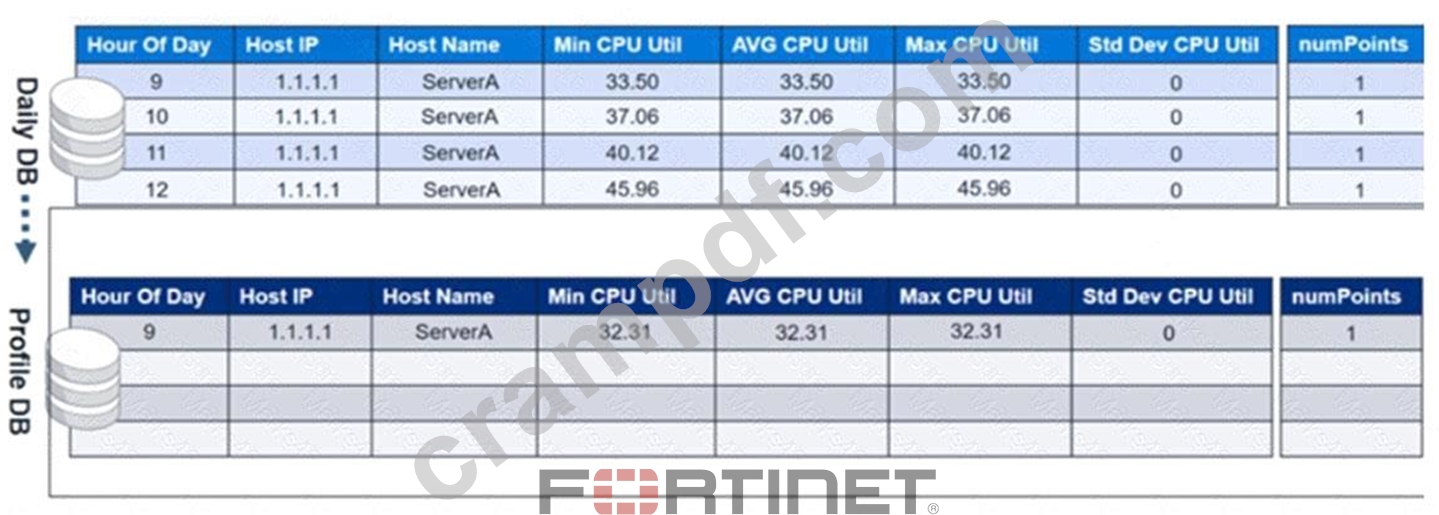
The profile database contains CPU utilization values from day one. At midnight on the second day, the CPU utilization values from the daily database will be merged with the profile database.
In the profile database, in the Hour of Day column where 9 is the value, what will be the updated minimum, maximum, and average CPU utilization values?
- A. Min CPU Util=32.31, Max CPU Ucil=33.50 and AVG CPU Util=32.67
- B. Min CPU Util=32.31, Max CPU Ucil=33.50 and AVG CPU Util=33.50
- C. Min CPU Util=32.31, Max CPU Ucil=32.31 and AVG CPU Util=32.31
- D. Min CPU Util=33.50, Max CPU Ucil=33.50 and AVG CPU Util=33.50
Answer: A
Explanation:
Explanation
The profile database contains CPU utilization values from day one. At midnight on the second day, the CPU utilization values from the daily database will be merged with the profile database using a weighted average formula:
New value = (Old value x Old weight) + (New value x New weight) / (Old weight + New weight) The weight is determined by the number of days in each database. In this case, the profile database has one day of data and the daily database has one day of data, so the weight is equal for both databases. Therefore, the formula simplifies to:
New value = (Old value + New value) / 2
In the profile database, in the Hour of Day column where 9 is the value, the updated minimum, maximum, and average CPU utilization values are:
Min CPU Util = (32.31 + 32.31) / 2 = 32.31 Max CPU Util = (33.50 + 33.50) / 2 = 33.50 AVG CPU Util = (32.67 + 32.67) / 2 = 32.67
NEW QUESTION # 27
Refer to the exhibit.
The exhibit shows the output of an SQL command that an administrator ran to view the natural_id value, after logging into the Postgres database.
What does the natural_id value identify?
- A. The collector
- B. An agent
- C. The supervisor
- D. The worker
Answer: A
Explanation:
Explanation
The natural_id value identifies the collector in the FortiSIEM system. The natural_id is a unique identifier that is assigned to each collector during the registration process with the supervisor. The natural_id is used to associate events and performance data with the collector that collected them.
NEW QUESTION # 28
On which disk are the SQLite databases that are used for the baselining stored?
- A. Disk3
- B. Disk4
- C. Disk1
- D. Disk2
Answer: A
Explanation:
Explanation
The SQLite databases that are used for the baselining are stored on Disk3 of the FortiSIEM server. Disk3 is also used for storing raw event data and CMDB data.
NEW QUESTION # 29
From where does the rule engine load the baseline data values?
- A. The profile database
- B. The profile report
- C. The daily database
- D. The memory
Answer: A
Explanation:
Explanation
The rule engine loads the baseline data values from the profile database. The profile database contains historical data that is used for baselining calculations, such as minimum, maximum, average, standard deviation, and percentile values for various metrics.
NEW QUESTION # 30
Which of the following are two Tactics in the MITRE ATT&CK framework? (Choose two.)
- A. Root kit
- B. Reconnaissance
- C. Discovery
- D. Phishing
- E. BITS Jobs
Answer: B,C
Explanation:
Explanation
Reconnaissance and Discovery are two Tactics in the MITRE ATT&CK framework. Tactics are the high-level objectives of an adversary, such as initial access, persistence, lateral movement, etc. Reconnaissance is the tactic of gathering information about a target before launching an attack. Discovery is the tactic of exploring a compromised system or network to find information or assets of interest. References: Fortinet NSE 7 - Advanced Analytics 6.3 Exam Description, page 21
NEW QUESTION # 31
Refer to the exhibit.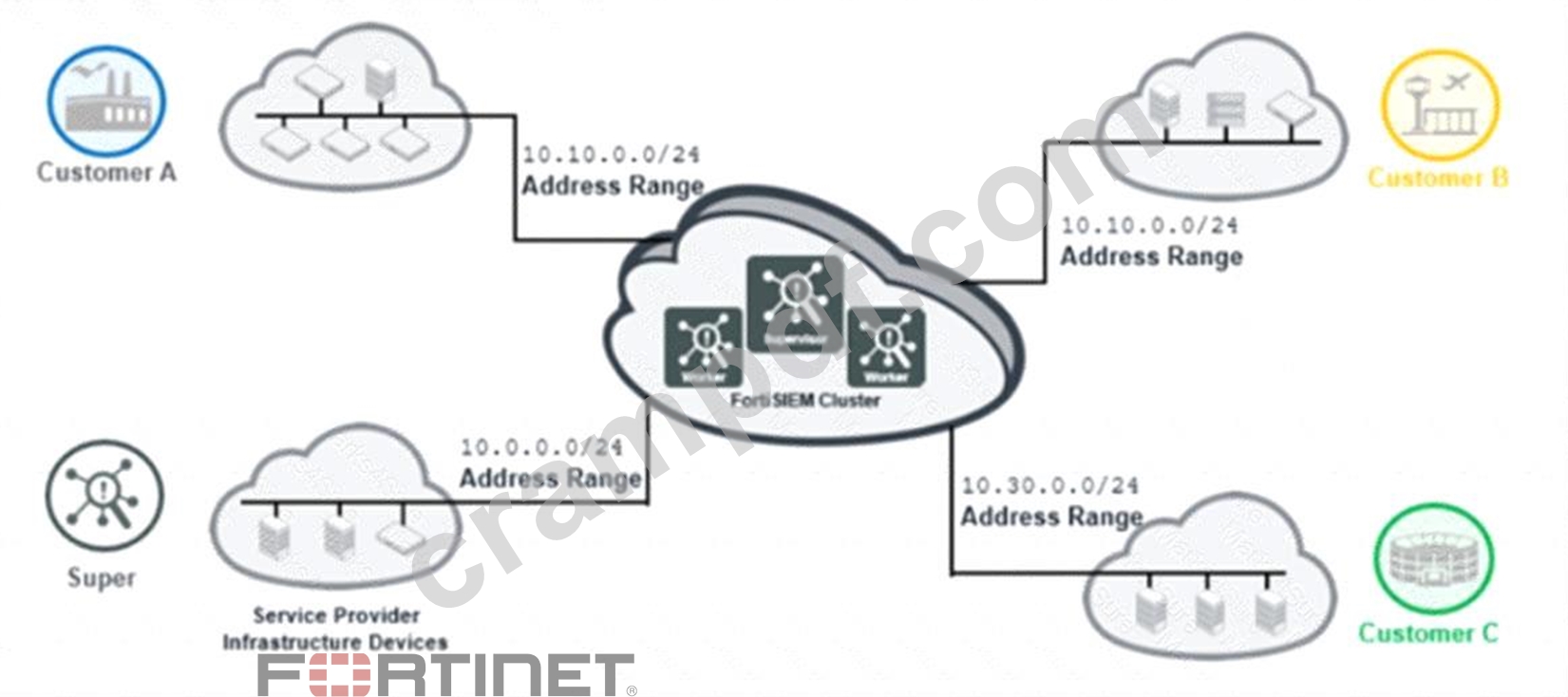
The service provider deployed FortiSIEM without a collector and added three customers on the supervisor.
What mistake did the administrator make?
- A. Collectors must be deployed on all customer premises before they are added to organizations on the supervisor.
- B. Customer A and customer B have overlapping IP addresses.
- C. At least one collector must be deployed to collect logs from service provider infrastructure devices.
- D. The number of workers on the FortiSIEM cluster must match the number of customers added.
Answer: B
Explanation:
Explanation
The mistake that the administrator made is that customer A and customer B have overlapping IP addresses.
This will cause confusion and errors in event collection and correlation, as well as CMDB discovery and classification. To avoid this problem, each customer should have a unique IP address range or use NAT to translate their IP addresses.
NEW QUESTION # 32
Refer to the exhibit.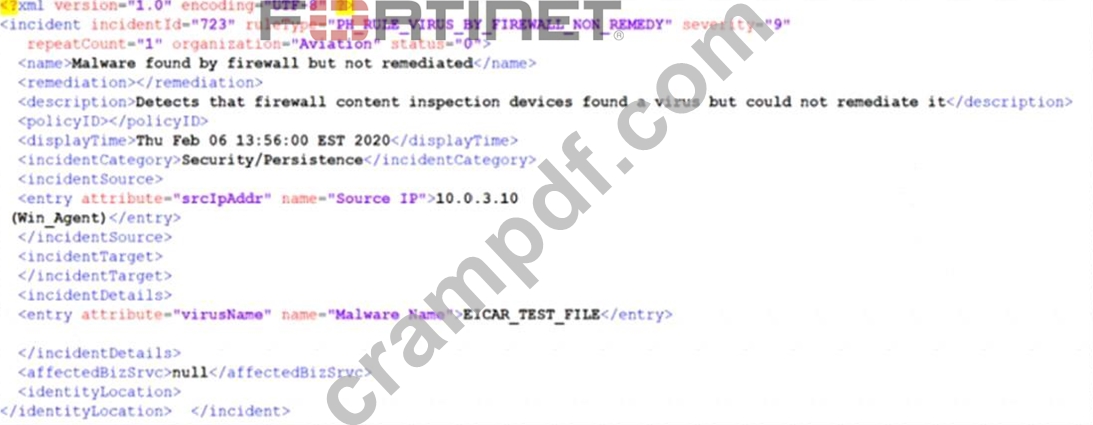
An administrator wants to remediate the incident from FortiSIEM shown in the exhibit.
What option is available to the administrator?
- A. Run the block domain Windows DNS
- B. Quarantine IP FortiClient
- C. Run the block MAC FortiOS.
- D. Run the block IP FortiOS 5.4
Answer: D
Explanation:
Explanation
The incident from FortiSIEM shown in the exhibit is a brute force attack on a FortiGate device. The remediation option available to the administrator is to run the block IP FortiOS 5.4 action, which will block the source IP address of the attacker on the FortiGate device using a firewall policy.
NEW QUESTION # 33
How can you invoke an integration policy on FortiSIEM rules?
- A. Through remediation scripts
- B. Through Notification Policy settings
- C. Through Incident Notification settings
- D. Through External Authentication settings
Answer: B
Explanation:
Explanation
You can invoke an integration policy on FortiSIEM rules by configuring the Notification Policy settings. You can select an integration policy from the drop-down list and specify the conditions for triggering it. For example, you can invoke an integration policy when an incident is created, updated, or closed.
References: Fortinet NSE 7 - Advanced Analytics 6.3 Exam Description, page 9
NEW QUESTION # 34
Refer to the exhibit.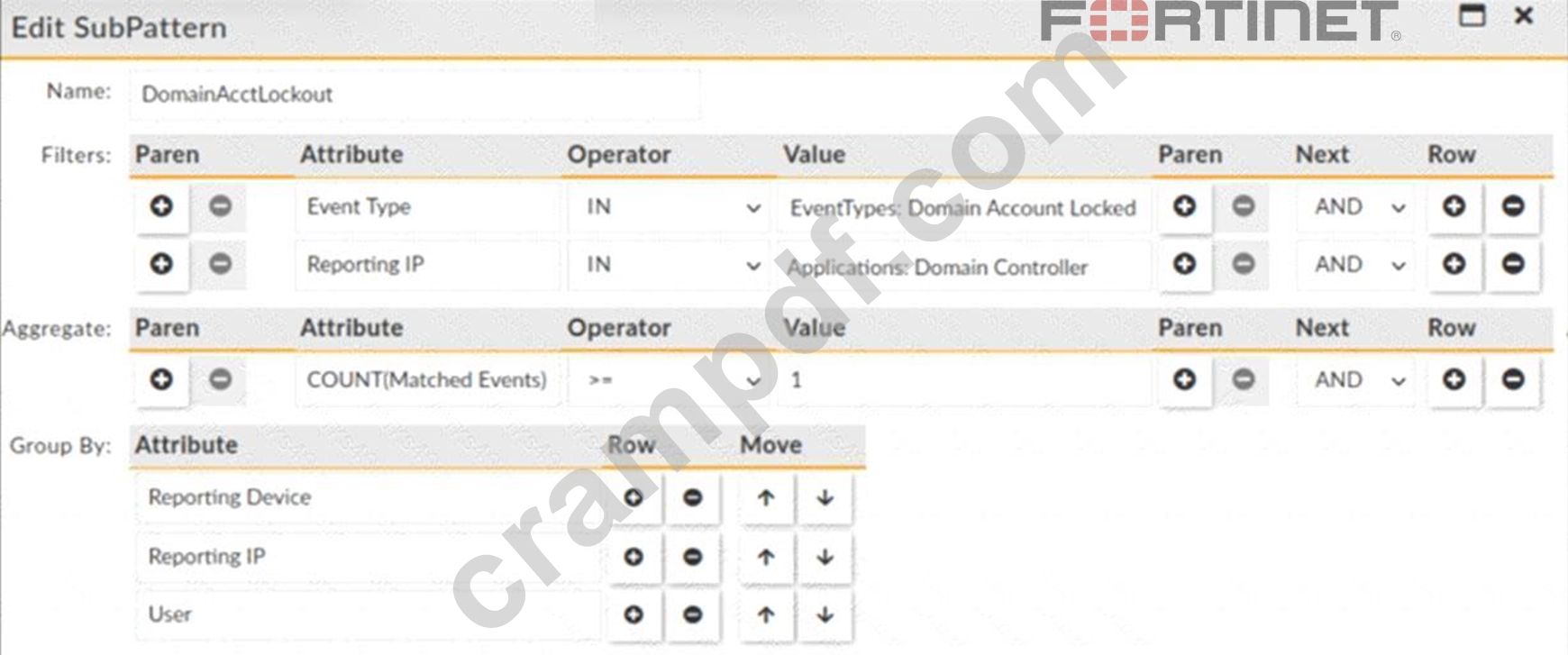
Which statement about the rule filters events shown in the exhibit is true?
- A. The rule filters events with an event type that belong to the Domain Account Locked CMDB group or a reporting IP that belong to the Domain Controller applications group.
- B. The rule filters events with an event type that belong to the Domain Account Locked CMDB group and a user that belongs to the Domain Controller applications group.
- C. The rule filters events with an event type that belong to the Domain Account Locked CMDB group and a reporting |P that belong to the Domain Controller applications group.
- D. The rule filters events with an event type that equals Domain Account Locked and a reporting IP that equals Domain Controller applications.
Answer: C
Explanation:
Explanation
The rule filters events with an event type that belong to the Domain Account Locked CMDB group and a reporting IP that belong to the Domain Controller applications group. This means that only events that have both criteria met will be processed by this rule. The event type and reporting IP are joined by an AND operator, which requires both conditions to be true.
NEW QUESTION # 35
......
Check the Free demo of our NSE7_ADA-6.3 Exam Dumps with 36 Questions: https://www.crampdf.com/NSE7_ADA-6.3-exam-prep-dumps.html
Verified NSE7_ADA-6.3 Q&As - Pass Guarantee NSE7_ADA-6.3 Exam Dumps: https://drive.google.com/open?id=1Aquq4qqjg6wCoFS094PgXwS-NCU-gcTQ