


ML Data Scientist Certified Official Practice Test Databricks-Machine-Learning-Associate - Feb-2025
Ace Databricks Databricks-Machine-Learning-Associate Certification with Actual Questions Feb 20, 2025 Updated
NEW QUESTION # 41
A data scientist is developing a machine learning pipeline using AutoML on Databricks Machine Learning.
Which of the following steps will the data scientist need to perform outside of their AutoML experiment?
- A. Exploratory data analysis
- B. Model deployment
- C. Model tuning
- D. Model evaluation
Answer: A
Explanation:
AutoML platforms, such as the one available in Databricks Machine Learning, streamline various stages of the machine learning pipeline including feature engineering, model selection, hyperparameter tuning, and model evaluation. However, exploratory data analysis (EDA) is typically performed outside the AutoML process. EDA involves understanding the dataset, visualizing distributions, identifying anomalies, and gaining insights into data before feeding it into a machine learning pipeline. This step is crucial for ensuring that the data is clean and suitable for model training but is generally done manually by the data scientist.
Reference
Databricks documentation on AutoML: https://docs.databricks.com/applications/machine-learning/automl.html
NEW QUESTION # 42
In which of the following situations is it preferable to impute missing feature values with their median value over the mean value?
- A. When the features contain no outliers
- B. When the features contain a lot of extreme outliers
- C. When the features are of the categorical type
- D. When the features contain no missing no values
- E. When the features are of the boolean type
Answer: B
Explanation:
Imputing missing values with the median is often preferred over the mean in scenarios where the data contains a lot of extreme outliers. The median is a more robust measure of central tendency in such cases, as it is not as heavily influenced by outliers as the mean. Using the median ensures that the imputed values are more representative of the typical data point, thus preserving the integrity of the dataset's distribution. The other options are not specifically relevant to the question of handling outliers in numerical data.
Reference:
Data Imputation Techniques (Dealing with Outliers).
NEW QUESTION # 43
A data scientist is using Spark ML to engineer features for an exploratory machine learning project.
They decide they want to standardize their features using the following code block: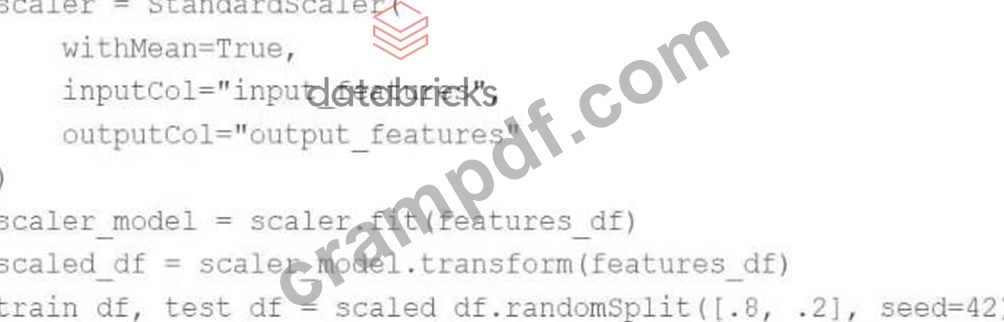
Upon code review, a colleague expressed concern with the features being standardized prior to splitting the data into a training set and a test set.
Which of the following changes can the data scientist make to address the concern?
- A. Utilize the Pipeline API to standardize the test data according to the training data's summary statistics
- B. Utilize a cross-validation process rather than a train-test split process to remove the need for standardizing data
- C. Utilize the Pipeline API to standardize the training data according to the test data's summary statistics
- D. Utilize the MinMaxScaler object to standardize the test data according to global minimum and maximum values
- E. Utilize the MinMaxScaler object to standardize the training data according to global minimum and maximum values
Answer: A
Explanation:
To address the concern about standardizing features prior to splitting the data, the correct approach is to use the Pipeline API to ensure that only the training data's summary statistics are used to standardize the test data. This is achieved by fitting the StandardScaler (or any scaler) on the training data and then transforming both the training and test data using the fitted scaler. This approach prevents information leakage from the test data into the model training process and ensures that the model is evaluated fairly.
Reference:
Best Practices in Preprocessing in Spark ML (Handling Data Splits and Feature Standardization).
NEW QUESTION # 44
A data scientist has produced two models for a single machine learning problem. One of the models performs well when one of the features has a value of less than 5, and the other model performs well when the value of that feature is greater than or equal to 5. The data scientist decides to combine the two models into a single machine learning solution.
Which of the following terms is used to describe this combination of models?
- A. Bootstrap aggregation
- B. Bucketing
- C. Stacking
- D. Ensemble learning
- E. Support vector machines
Answer: D
Explanation:
Ensemble learning is a machine learning technique that involves combining several models to solve a particular problem. The scenario described fits the concept of ensemble learning, where two models, each performing well under different conditions, are combined to create a more robust model. This approach often leads to better performance as it combines the strengths of multiple models.
Reference
Introduction to Ensemble Learning: https://machinelearningmastery.com/ensemble-machine-learning-algorithms-python-scikit-learn/
NEW QUESTION # 45
A machine learning engineer wants to parallelize the training of group-specific models using the Pandas Function API. They have developed the train_model function, and they want to apply it to each group of DataFrame df.
They have written the following incomplete code block: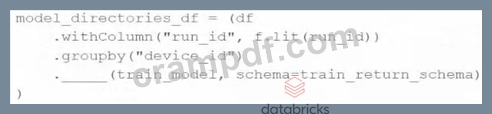
Which of the following pieces of code can be used to fill in the above blank to complete the task?
- A. groupedApplyIn
- B. applyInPandas
- C. predict
- D. mapInPandas
- E. train_model
Answer: D
Explanation:
The function mapInPandas in the PySpark DataFrame API allows for applying a function to each partition of the DataFrame. When working with grouped data, groupby followed by applyInPandas is the correct approach to apply a function to each group as a separate Pandas DataFrame. However, if the function should apply across each partition of the grouped data rather than on each individual group, mapInPandas would be utilized. Since the code snippet indicates the use of groupby, the intent seems to be to apply train_model on each group specifically, which aligns with applyInPandas. Thus, applyInPandas is a better fit to ensure that each group generated by groupby is processed through the train_model function, preserving the partitioning and grouping integrity.
Reference
PySpark Documentation on applying functions to grouped data: https://spark.apache.org/docs/latest/api/python/reference/api/pyspark.sql.GroupedData.applyInPandas.html
NEW QUESTION # 46
A data scientist is using Spark SQL to import their data into a machine learning pipeline. Once the data is imported, the data scientist performs machine learning tasks using Spark ML.
Which of the following compute tools is best suited for this use case?
- A. Single Node cluster
- B. Standard cluster
- C. None of these compute tools support this task
- D. SQL Warehouse
Answer: B
Explanation:
For a data scientist using Spark SQL to import data and then performing machine learning tasks using Spark ML, the best-suited compute tool is a Standard cluster. A Standard cluster in Databricks provides the necessary resources and scalability to handle large datasets and perform distributed computing tasks efficiently, making it ideal for running Spark SQL and Spark ML operations.
Reference:
Databricks documentation on clusters: Clusters in Databricks
NEW QUESTION # 47
A machine learning engineer wants to parallelize the inference of group-specific models using the Pandas Function API. They have developed the apply_model function that will look up and load the correct model for each group, and they want to apply it to each group of DataFrame df.
They have written the following incomplete code block:
Which piece of code can be used to fill in the above blank to complete the task?
- A. applyInPandas
- B. predict
- C. groupedApplyInPandas
- D. mapInPandas
Answer: A
Explanation:
To parallelize the inference of group-specific models using the Pandas Function API in PySpark, you can use the applyInPandas function. This function allows you to apply a Python function on each group of a DataFrame and return a DataFrame, leveraging the power of pandas UDFs (user-defined functions) for better performance.
prediction_df = ( df.groupby("device_id") .applyInPandas(apply_model, schema=apply_return_schema) ) In this code:
groupby("device_id"): Groups the DataFrame by the "device_id" column.
applyInPandas(apply_model, schema=apply_return_schema): Applies the apply_model function to each group and specifies the schema of the return DataFrame.
Reference:
PySpark Pandas UDFs Documentation
NEW QUESTION # 48
The implementation of linear regression in Spark ML first attempts to solve the linear regression problem using matrix decomposition, but this method does not scale well to large datasets with a large number of variables.
Which of the following approaches does Spark ML use to distribute the training of a linear regression model for large data?
- A. Spark ML cannot distribute linear regression training
- B. Least-squares method
- C. Logistic regression
- D. Singular value decomposition
- E. Iterative optimization
Answer: E
NEW QUESTION # 49
A data scientist has been given an incomplete notebook from the data engineering team. The notebook uses a Spark DataFrame spark_df on which the data scientist needs to perform further feature engineering. Unfortunately, the data scientist has not yet learned the PySpark DataFrame API.
Which of the following blocks of code can the data scientist run to be able to use the pandas API on Spark?
- A. import pyspark.pandas as ps
df = ps.to_pandas(spark_df) - B. import pyspark.pandas as ps
df = ps.DataFrame(spark_df) - C. spark_df.to_pandas()
- D. import pandas as pd
df = pd.DataFrame(spark_df)
Answer: B
Explanation:
To use the pandas API on Spark, the data scientist can run the following code block:
import pyspark.pandas as ps df = ps.DataFrame(spark_df)
This code imports the pandas API on Spark and converts the Spark DataFrame spark_df into a pandas-on-Spark DataFrame, allowing the data scientist to use familiar pandas functions for further feature engineering.
Reference:
Databricks documentation on pandas API on Spark: pandas API on Spark
NEW QUESTION # 50
A machine learning engineer is trying to scale a machine learning pipeline by distributing its feature engineering process.
Which of the following feature engineering tasks will be the least efficient to distribute?
- A. Creating binary indicator features for missing values
- B. Target encoding categorical features
- C. One-hot encoding categorical features
- D. Imputing missing feature values with the mean
- E. Imputing missing feature values with the true median
Answer: E
Explanation:
Among the options listed, calculating the true median for imputing missing feature values is the least efficient to distribute. This is because the true median requires knowledge of the entire data distribution, which can be computationally expensive in a distributed environment. Unlike mean or mode, finding the median requires sorting the data or maintaining a full distribution, which is more intensive and often requires shuffling the data across partitions.
Reference
Challenges in parallel processing and distributed computing for data aggregation like median calculation: https://www.apache.org
NEW QUESTION # 51
A data scientist has developed a random forest regressor rfr and included it as the final stage in a Spark MLPipeline pipeline. They then set up a cross-validation process with pipeline as the estimator in the following code block: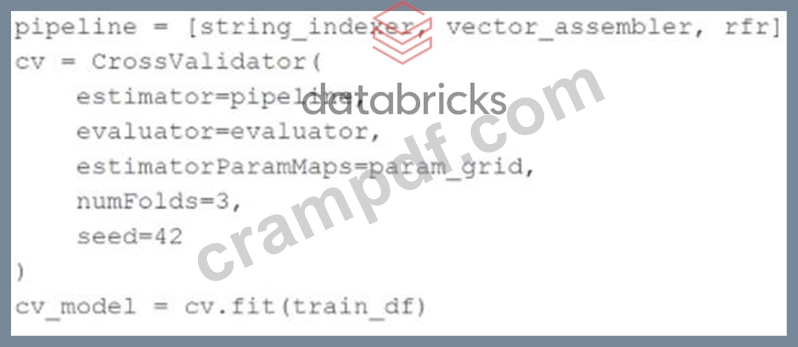
Which of the following is a negative consequence of including pipeline as the estimator in the cross-validation process rather than rfr as the estimator?
- A. The process will leak data prep information from the validation sets to the training sets for each model
- B. The process will be unable to parallelize tuning due to the distributed nature of pipeline
- C. The process will leak data from the training set to the test set during the evaluation phase
- D. The process will have a longer runtime because all stages of pipeline need to be refit or retransformed with each mode
Answer: D
Explanation:
Including the entire pipeline as the estimator in the cross-validation process means that all stages of the pipeline, including data preprocessing steps like string indexing and vector assembling, will be refit or retransformed for each fold of the cross-validation. This results in a longer runtime because each fold requires re-execution of these preprocessing steps, which can be computationally expensive.
If only the random forest regressor (rfr) were included as the estimator, the preprocessing steps would be performed once, and only the model fitting would be repeated for each fold, significantly reducing the computational overhead.
Reference:
Databricks documentation on cross-validation: Cross Validation
NEW QUESTION # 52
A data scientist has produced three new models for a single machine learning problem. In the past, the solution used just one model. All four models have nearly the same prediction latency, but a machine learning engineer suggests that the new solution will be less time efficient during inference.
In which situation will the machine learning engineer be correct?
- A. When the new solution requires the use of fewer feature variables than the original model
- B. When the new solution's models have an average latency that is larger than the size of the original model
- C. When the new solution's models have an average size that is larger than the size of the original model
- D. When the new solution requires if-else logic determining which model to use to compute each prediction
- E. When the new solution requires that each model computes a prediction for every record
Answer: E
Explanation:
If the new solution requires that each of the three models computes a prediction for every record, the time efficiency during inference will be reduced. This is because the inference process now involves running multiple models instead of a single model, thereby increasing the overall computation time for each record.
In scenarios where inference must be done by multiple models for each record, the latency accumulates, making the process less time efficient compared to using a single model.
Reference:
Model Ensemble Techniques
NEW QUESTION # 53
A data scientist learned during their training to always use 5-fold cross-validation in their model development workflow. A colleague suggests that there are cases where a train-validation split could be preferred over k-fold cross-validation when k > 2.
Which of the following describes a potential benefit of using a train-validation split over k-fold cross-validation in this scenario?
- A. Fewer models need to be trained when using a train-validation split
- B. Bias is avoidable when using a train-validation split
- C. Fewer hyperparameter values need to be tested when using a train-validation split
- D. Reproducibility is achievable when using a train-validation split
- E. A holdout set is not necessary when using a train-validation split
Answer: A
NEW QUESTION # 54
An organization is developing a feature repository and is electing to one-hot encode all categorical feature variables. A data scientist suggests that the categorical feature variables should not be one-hot encoded within the feature repository.
Which of the following explanations justifies this suggestion?
- A. One-hot encoding is not supported by most machine learning libraries.
- B. One-hot encoding is not a common strategy for representing categorical feature variables numerically.
- C. One-hot encoding is computationally intensive and should only be performed on small samples of training sets for individual machine learning problems.
- D. One-hot encoding is dependent on the target variable's values which differ for each application.
- E. One-hot encoding is a potentially problematic categorical variable strategy for some machine learning algorithms.
Answer: E
Explanation:
One-hot encoding transforms categorical variables into a format that can be provided to machine learning algorithms to better predict the output. However, when done prematurely or universally within a feature repository, it can be problematic:
Dimensionality Increase: One-hot encoding significantly increases the feature space, especially with high cardinality features, which can lead to high memory consumption and slower computation.
Model Specificity: Some models handle categorical variables natively (like decision trees and boosting algorithms), and premature one-hot encoding can lead to inefficiency and loss of information (e.g., ordinal relationships).
Sparse Matrix Issue: It often results in a sparse matrix where most values are zero, which can be inefficient in both storage and computation for some algorithms.
Generalization vs. Specificity: Encoding should ideally be tailored to specific models and use cases rather than applied generally in a feature repository.
Reference
"Feature Engineering and Selection: A Practical Approach for Predictive Models" by Max Kuhn and Kjell Johnson (CRC Press, 2019).
NEW QUESTION # 55
Which statement describes a Spark ML transformer?
- A. A transformer chains multiple algorithms together to transform an ML workflow
- B. A transformer is a learning algorithm that can use a DataFrame to train a model
- C. A transformer is a hyperparameter grid that can be used to train a model
- D. A transformer is an algorithm which can transform one DataFrame into another DataFrame
Answer: D
Explanation:
In Spark ML, a transformer is an algorithm that can transform one DataFrame into another DataFrame. It takes a DataFrame as input and produces a new DataFrame as output. This transformation can involve adding new columns, modifying existing ones, or applying feature transformations. Examples of transformers in Spark MLlib include feature transformers like StringIndexer, VectorAssembler, and StandardScaler.
Reference:
Databricks documentation on transformers: Transformers in Spark ML
NEW QUESTION # 56
Which of the following tools can be used to distribute large-scale feature engineering without the use of a UDF or pandas Function API for machine learning pipelines?
- A. pandas
- B. Spark ML
- C. Keras
- D. PvTorch
- E. Scikit-learn
Answer: B
Explanation:
Spark ML (Machine Learning Library) is designed specifically for handling large-scale data processing and machine learning tasks directly within Apache Spark. It provides tools and APIs for large-scale feature engineering without the need to rely on user-defined functions (UDFs) or pandas Function API, allowing for more scalable and efficient data transformations directly distributed across a Spark cluster. Unlike Keras, pandas, PyTorch, and scikit-learn, Spark ML operates natively in a distributed environment suitable for big data scenarios.
Reference:
Spark MLlib documentation (Feature Engineering with Spark ML).
NEW QUESTION # 57
A data scientist learned during their training to always use 5-fold cross-validation in their model development workflow. A colleague suggests that there are cases where a train-validation split could be preferred over k-fold cross-validation when k > 2.
Which of the following describes a potential benefit of using a train-validation split over k-fold cross-validation in this scenario?
- A. Fewer models need to be trained when using a train-validation split
- B. Bias is avoidable when using a train-validation split
- C. Fewer hyperparameter values need to be tested when using a train-validation split
- D. Reproducibility is achievable when using a train-validation split
- E. A holdout set is not necessary when using a train-validation split
Answer: A
Explanation:
A train-validation split is often preferred over k-fold cross-validation (with k > 2) when computational efficiency is a concern. With a train-validation split, only two models (one on the training set and one on the validation set) are trained, whereas k-fold cross-validation requires training k models (one for each fold).
This reduction in the number of models trained can save significant computational resources and time, especially when dealing with large datasets or complex models.
Reference:
Model Evaluation with Train-Test Split
NEW QUESTION # 58
An organization is developing a feature repository and is electing to one-hot encode all categorical feature variables. A data scientist suggests that the categorical feature variables should not be one-hot encoded within the feature repository.
Which of the following explanations justifies this suggestion?
- A. One-hot encoding is not a common strategy for representing categorical feature variables numerically.
- B. One-hot encoding is computationally intensive and should only be performed on small samples of training sets for individual machine learning problems.
- C. One-hot encoding is dependent on the target variable's values which differ for each apaplication.
- D. One-hot encoding is a potentially problematic categorical variable strategy for some machine learning algorithms.
Answer: D
Explanation:
The suggestion not to one-hot encode categorical feature variables within the feature repository is justified because one-hot encoding can be problematic for some machine learning algorithms. Specifically, one-hot encoding increases the dimensionality of the data, which can be computationally expensive and may lead to issues such as multicollinearity and overfitting. Additionally, some algorithms, such as tree-based methods, can handle categorical variables directly without requiring one-hot encoding.
Reference:
Databricks documentation on feature engineering: Feature Engineering
NEW QUESTION # 59
Which of the following tools can be used to distribute large-scale feature engineering without the use of a UDF or pandas Function API for machine learning pipelines?
- A. Spark ML
- B. PyTorch
- C. Keras
- D. Scikit-learn
Answer: A
Explanation:
Spark MLlib is a machine learning library within Apache Spark that provides scalable and distributed machine learning algorithms. It is designed to work with Spark DataFrames and leverages Spark's distributed computing capabilities to perform large-scale feature engineering and model training without the need for user-defined functions (UDFs) or the pandas Function API. Spark MLlib provides built-in transformations and algorithms that can be applied directly to large datasets.
Reference:
Databricks documentation on Spark MLlib: Spark MLlib
NEW QUESTION # 60
A data scientist has replaced missing values in their feature set with each respective feature variable's median value. A colleague suggests that the data scientist is throwing away valuable information by doing this.
Which of the following approaches can they take to include as much information as possible in the feature set?
- A. Create a constant feature variable for each feature that contained missing values indicating the percentage of rows from the feature that was originally missing
- B. Remove all feature variables that originally contained missing values from the feature set
- C. Refrain from imputing the missing values in favor of letting the machine learning algorithm determine how to handle them
- D. Impute the missing values using each respective feature variable's mean value instead of the median value
- E. Create a binary feature variable for each feature that contained missing values indicating whether each row's value has been imputed
Answer: E
Explanation:
By creating a binary feature variable for each feature with missing values to indicate whether a value has been imputed, the data scientist can preserve information about the original state of the data. This approach maintains the integrity of the dataset by marking which values are original and which are synthetic (imputed). Here are the steps to implement this approach:
Identify Missing Values: Determine which features contain missing values.
Impute Missing Values: Continue with median imputation or choose another method (mean, mode, regression, etc.) to fill missing values.
Create Indicator Variables: For each feature that had missing values, add a new binary feature. This feature should be '1' if the original value was missing and imputed, and '0' otherwise.
Data Integration: Integrate these new binary features into the existing dataset. This maintains a record of where data imputation occurred, allowing models to potentially weight these observations differently.
Model Adjustment: Adjust machine learning models to account for these new features, which might involve considering interactions between these binary indicators and other features.
Reference
"Feature Engineering for Machine Learning" by Alice Zheng and Amanda Casari (O'Reilly Media, 2018), especially the sections on handling missing data.
Scikit-learn documentation on imputing missing values: https://scikit-learn.org/stable/modules/impute.html
NEW QUESTION # 61
......
Try Free and Start Using Realistic Verified Databricks-Machine-Learning-Associate Dumps Instantly.: https://www.crampdf.com/Databricks-Machine-Learning-Associate-exam-prep-dumps.html
2025 The Most Effective Databricks-Machine-Learning-Associate with 76 Questions Answers: https://drive.google.com/open?id=1gblvywqonDdgj0y5bgFwmzBK65Q1tYeU