


Jun-2026 Free DP-600 Test Questions Real Practice Test Questions
DP-600 Dumps Updated Jun 06, 2026 WIith 166 Questions
Microsoft DP-600 Exam Syllabus Topics:
| Topic | Details |
|---|---|
| Topic 1 |
|
| Topic 2 |
|
| Topic 3 |
|
NEW QUESTION # 23
You have a Fabric eventhouse named Eventhousel that contains a table named Weatherdata. A sample of the data in Weatherdata is shown in the following table.
You plan to use a KQL queryset to manipulate the data in Eventhouse1. The result set must have the following columns.
You need to build the query.
Which four KQL statements should you use in sequence? To answer, move the appropriate statements from the list of statements to the answer area and arrange them in the correct order.
Answer:
Explanation: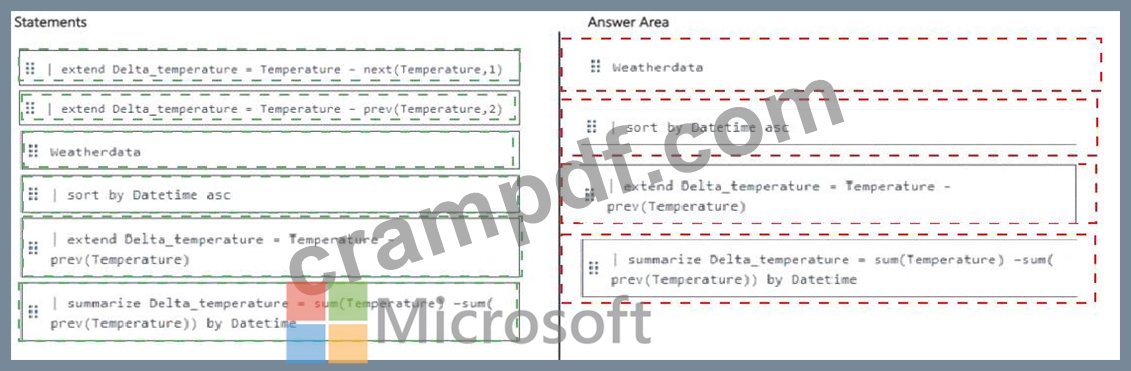
Explanation:
NEW QUESTION # 24
You have a Microsoft Power Bl project that contains a semantic model. You plan to use Azure DevOps for version control.
You need to modify the .gitignore file to prevent the data values from the data sources from being pushed to the repository. Which file should you reference?
- A. cache.abf
- B. localSettings.json
- C. unappliedChanges.json
- D. model.bim
Answer: B
Explanation:
When using Power BI Project (.pbip) with Git integration:
The .pbip project separates model metadata (schema, measures, relationships, etc.) from actual data values.
The localSettings.json file stores machine-specific and environment-specific settings, including data source credentials and local configurations. These should not be checked into version control to avoid exposing sensitive information or environment-specific configs.
Other options:
unappliedChanges.json # tracks unsaved changes, not data values.
model.bim # defines the semantic model schema (measures, relationships, metadata) and must be included in version control.
cache.abf # stores Analysis Services cache data, not part of source control.
Therefore, the correct file to exclude is localSettings.json.
ference:
Power BI Projects and Git integration
localSettings.json in PBIP projects
NEW QUESTION # 25
You have a Fabric tenant that contains a workspace named Workspace1. Workspace1 contains a data pipeline named Pipeline1 and a lakehouse named Lakehouse1.
You perform the following actions:
Create a workspace named Workspace2.
Create a deployment pipeline named DeployPipeline1 that will deploy items from Workspace1 to Workspace2.
Add a folder named Folder1 to Workspace1.
Move Lakehouse1 to Folder1.
Run DeployPipeline1.
Which structure will Workspace2 have when DeployPipeline1 is complete?
- A. \Pipeline1
\Folder1\Lakehouse1 - B. \Folder1\Pipeline1
\Folder1\Lakehouse1 - C. \Pipeline1
\Lakehouse1 - D. \Folder1Lakehouse1
Answer: A
Explanation:
Scenario:
Workspace1 contains: Pipeline1 and Lakehouse1.
A folder named Folder1 is created in Workspace1.
Lakehouse1 is moved into Folder1.
A deployment pipeline DeployPipeline1 deploys from Workspace1 # Workspace2.
Key Behavior:
Deployment pipelines in Microsoft Fabric maintain the folder hierarchy of items when deploying between workspaces.
If an item (Lakehouse1) is placed in a folder (Folder1), the same folder structure is replicated in the target workspace.
Items not placed in the folder (Pipeline1) remain at the root level.
Result in Workspace2 after deployment:
Pipeline1 remains at the root.
Lakehouse1 is placed inside Folder1.
NEW QUESTION # 26
You have a Fabric workspace that contains a complex semantic model for a Microsoft Power BI report. You need to optimize the semantic model for analytical queries and use denormalization to reduce the model complexity and the number of joins between tables.
Which tables should you denormalize?
- A. role-playing dimension tables
- B. fact tables on the same level of granularity
- C. dimension tables on the same level of granularity
- D. Snowflaked dimension tables
Answer: D
NEW QUESTION # 27
You are implementing two dimension tables named Customers and Products in a Fabric warehouse.
You need to use slowly changing dimension (SCO) to manage the versioning of dat a. The solution must meet the requirements shown in the following table.
Which type of SCD should you use for each table? To answer, drag the appropriate SCD types to the correct tables. Each SCD type may be used once, more than once, or not at all. You may need to drag the split bar between panes or scroll to view content.
NOTE: Each correct selection is worth one point.
Answer:
Explanation:
NEW QUESTION # 28
You have a Fabric tenant that contains a lakehouse named Lakehouse1.
You need to prevent new tables added to Lakehouse1 from being added automatically to the default semantic model of the lakehouse.
What should you configure? (5)
- A. the Lakehouse1 settings
- B. the SQL analytics endpoint settings
- C. the semantic model settings
- D. the workspace settings
Answer: B
Explanation:
To prevent new tables added to Lakehouse1 from being automatically added to the default semantic model, you should configure the semantic model settings. There should be an option within the settings of the semantic model to include or exclude new tables by default. By adjusting these settings, you can control the automatic inclusion of new tables.
NEW QUESTION # 29
You have a Fabric tenant that contains a semantic model. The model uses Direct Lake mode.
You suspect that some DAX queries load unnecessary columns into memory.
You need to identify the frequently used columns that are loaded into memory.
What are two ways to achieve the goal? Each correct answer presents a complete solution.
NOTE: Each correct answer is worth one point.
- A. Query the discover_hehory6Rant dynamic management view (DMV).
- B. Use the Vertipaq Analyzer tool.
- C. Use the Analyze in Excel feature.
- D. Query the $system.discovered_STORAGE_TABLE_COLUMN-iN_SEGMeNTS dynamic management view (DMV).
Answer: B,D
Explanation:
The Vertipaq Analyzer tool (B) and querying the
$system.discovered_STORAGE_TABLE_COLUMNS_IN_SEGMENTS dynamic management view (DMV) (C) can help identify which columns are frequently loaded into memory. Both methods provide insights into the storage and retrieval aspects of the semantic model. References = The Power BI documentation on Vertipaq Analyzer and DMV queries offers detailed guidance on how to use these tools for performance analysis.
NEW QUESTION # 30
You have a Fabric workspace named Workspace1 that contains a data flow named Dataflow1. Dataflow1 contains a query that returns the data shown in the following exhibit.
You need to transform the date columns into attribute-value pairs, where columns become rows.
You select the VendorlD column.
Which transformation should you select from the context menu of the VendorlD column?
- A. Remove other columns
- B. Unpivot other columns
- C. Group by
- D. Unpivot columns
- E. Split column
Answer: D
Explanation:
The transformation you should select from the context menu of the VendorID column to transform the date columns into attribute-value pairs, where columns become rows, is Unpivot columns (B). This transformation will turn the selected columns into rows with two new columns, one for the attribute (the original column names) and one for the value (the data from the cells). References = Techniques for unpivoting columns are covered in the Power Query documentation, which explains how to use the transformation in data modeling.
NEW QUESTION # 31
You have a Microsoft Power Bl project that contains a file named definition.pbir. definition.pbir contains the following JSON.
For each of the following statements, select Yes if the statement is true. Otherwise, select No. NOTE: Each correct selection is worth one point.
Answer:
Explanation:
Explanation:
NEW QUESTION # 32
You have a Fabric tenant that contains a warehouse named Warehouse1. Warehouse1 contains three schemas named schemaA, schemaB. and schemaC You need to ensure that a user named User1 can truncate tables in schemaA only.
How should you complete the T-SQL statement? To answer, select the appropriate options in the answer area.
NOTE: Each correct selection is worth one point.
Answer:
Explanation:
Explanation:
* GRANT ALTER ON SCHEMA::schemaA TO User1;
The ALTER permission allows a user to modify the schema of an object, and granting ALTER on a schema will allow the user to perform operations like TRUNCATE TABLE on any object within that schema. It is the correct permission to grant to User1 for truncating tables in schemaA.
References =
* GRANT Schema Permissions
* Permissions That Can Be Granted on a Schema
NEW QUESTION # 33
You have a Fabric tenant that contains a semantic model.
You need to prevent report creators from populating visuals by using implicit measures.
What are two tools that you can use to achieve the goal? Each correct answer presents a complete solution.
NOTE: Each correct answer is worth one point.
- A. DAX Studio
- B. Microsoft SQL Server Management Studio (SSMS)
- C. Microsoft Power BI Desktop
- D. Tabular Editor
Answer: C,D
Explanation:
Microsoft Power BI Desktop (A) and Tabular Editor (B) are the tools you can use to prevent report creators from using implicit measures. In Power BI Desktop, you can define explicit measures which can be used in visuals. Tabular Editor allows for advanced model editing, where you can enforce the use of explicit measures. Reference = Guidance on using explicit measures and preventing implicit measures in reports can be found in the Power BI and Tabular Editor official documentation.
NEW QUESTION # 34
You have a Fabric tenant that contains a semantic model. The model contains data about retail stores.
You need to write a DAX query that will be executed by using the XMLA endpoint. The query must return the total amount of sales from the same period last year.
How should you complete the DAX expression? To answer, select the appropriate options in the answer are a. NOTE: Each correct selection is worth one point.
Answer:
Explanation:
NEW QUESTION # 35
Note: This question is part of a series of questions that present the same scenario. Each question in the series contains a unique solution that might meet the stated goals. Some question sets might have more than one correct solution, while others might not have a correct solution.
After you answer a question in this section, you will NOT be able to return to it. As a result, these questions will not appear in the review screen.
You have a Fabric tenant that contains a lakehouse named Lakehousel. Lakehousel contains a Delta table named Customer.
When you query Customer, you discover that the query is slow to execute. You suspect that maintenance was NOT performed on the table.
You need to identify whether maintenance tasks were performed on Customer.
Solution: You run the following Spark SQL statement:
DESCRIBE DETAIL customer
Does this meet the goal?
- A. Yes
- B. No
Answer: B
Explanation:
The command:
DESCRIBE DETAIL Customer
Returns metadata about the Delta table, such as format, schema, partitioning, size, number of files, and creation/modification timestamps.
However, it does not provide information about whether maintenance tasks (such as OPTIMIZE, VACUUM, or Z-Ordering) were performed on the table.
To check maintenance history, you would typically use:
DESCRIBE HISTORY Customer
which shows operations executed on the table (e.g., OPTIMIZE, VACUUM, MERGE).
Since DESCRIBE DETAIL does not satisfy the requirement, the solution does not meet the goal.
Reference:
DESCRIBE DETAIL in Delta Lake
DESCRIBE HISTORY in Delta Lake
NEW QUESTION # 36
Hotspot Question
You have a Fabric tenant that contains two lakehouses.
You are building a dataflow that will combine data from the lakehouses. The applied steps from one of the queries in the dataflow is shown in the following exhibit.
Use the drop-down menus to select the answer choice that completes each statement based on the information presented in the graphic.
NOTE: Each correct selection is worth one point.
Answer:
Explanation:
NEW QUESTION # 37
You have a Fabric tenant that contains a lakehouse named Lakehouse! Lakehouse1 contains a Delta table that has one million Parquet files.
You need to remove files that were NOT referenced by the table during the past 30 days. The solution must ensure that the transaction log remains consistent, and the ACID properties of the table are maintained What should you do?
- A. From OneLake file explorer, delete the files.
- B. Run the vacuum command.
- C. Run the optimize command and specify the v-order parameter.
- D. Run theOPTiMize command and specify the z-order parameter
Answer: B
Explanation:
VACUUM in Delta Lake removes unreferenced files older than a retention period (default 7 days, but configurable, e.g., 30 days).
It ensures that the transaction log remains consistent and ACID properties are maintained.
OPTIMIZE with V-Order or Z-Order improves file organization and query performance, but it does not remove unused files.
Deleting files manually from OneLake would break the transaction log consistency.
Correct answer: C. Run the VACUUM command.
Reference: VACUUM in Delta Lake
NEW QUESTION # 38
You have a Fabric tenant that contains a lakehouse.
You plan to query sales data files by using the SQL endpoint. The files will be in an Amazon Simple Storage Service (Amazon S3) storage bucket.
You need to recommend which file format to use and where to create a shortcut.
Which two actions should you include in the recommendation? Each correct answer presents part of the solution.
NOTE: Each correct answer is worth one point.
- A. Use the CSV format.
- B. Use the delta format.
- C. Use the Parquet format
- D. Create a shortcut in the Tables section.
- E. Create a shortcut in the Files section.
Answer: C,D
Explanation:
You should use a columnar file format such as Parquet or ORC (Optimized Row Columnar).
These formats are highly optimized for analytical queries and provide efficient storage and query performance.
In the Tables section of your lakehouse, you define virtual tables that represent external data sources. These virtual tables can be backed by data stored externally in formats such as Parquet or ORC in Amazon S3.
NEW QUESTION # 39
You have a KQL database that contains a table named Readings.
You need to query Readings and return the results shown in the following table.
How should you complete the query? To answer, select the appropriate options in the answer area.
NOTE: Each correct selection is worth one point.
Answer:
Explanation:
Explanation:
NEW QUESTION # 40
You have a Fabric notebook that has the Python code and output shown in the following exhibit.

Which type of analytics are you performing?
- A. diagnostic
- B. prescriptive
- C. descriptive
- D. predictive
Answer: C
Explanation:
The Python code and output shown in the exhibit display a histogram, which is a representation of the distribution of data. This kind of analysis is descriptive analytics, which is used to describe or summarize the features of a dataset. Descriptive analytics answers the question of "what has happened" by providing insight into past data through tools such as mean, median, mode, standard deviation, and graphical representations like histograms.
References: Descriptive analytics and the use of histograms as a way to visualize data distribution are basic concepts in data analysis, often covered in introductory analytics and Python programming resources.
NEW QUESTION # 41
You have a Fabric tenant tha1 contains a takehouse named Lakehouse1. Lakehouse1 contains a Delta table named Customer.
When you query Customer, you discover that the query is slow to execute. You suspect that maintenance was NOT performed on the table.
You need to identify whether maintenance tasks were performed on Customer.
Solution: You run the following Spark SQL statement:
REFRESH TABLE customer
Does this meet the goal?
- A. Yes
- B. No
Answer: B
Explanation:
No, the REFRESH TABLE statement does not provide information on whether maintenance tasks were performed. It only updates the metadata of a table to reflect any changes on the data files. References = The use and effects of the REFRESH TABLE command are explained in the Spark SQL documentation.
NEW QUESTION # 42
You have a Fabric tenant that contains a warehouse named WH1. You run the following T-SQL query against WH1.
For each of the following statements, select Yes if the statement is true. Otherwise, select No. NOTE: Each correct selection is worth one point.
Answer:
Explanation:
Explanation:
NEW QUESTION # 43
You have a Microsoft Power BI project that contains a semantic model.
You plan to use Azure DevOps for version control.
You need to modify the .gitignore file to prevent the data values from the data sources from being pushed to the repository.
Which file should you reference?
- A. cache.abf
- B. unappliedChanges.json
- C. model.bim
- D. localSettings.json
Answer: A
Explanation:
Justification: This file contains the cached data for the semantic model. It is a binary file and can be very large. Excluding this file from version control is necessary to prevent pushing large amounts of unnecessary data, and will prevent data from data sources from being pushed to the repository.
NEW QUESTION # 44
You have a Fabric tenant that contains a warehouse. The warehouse uses row-level security (RLS). You create a Direct Lake semantic model that uses the Delta tables and RLS of the warehouse. When users interact with a report built from the model, which mode will be used by the DAX queries?
- A. Dual
- B. DirectQuery
- C. Direct Lake
- D. Import
Answer: B
Explanation:
When users interact with a report built from a Direct Lake semantic model that uses row-level security (RLS), the DAX queries will operate in DirectQuery mode (A). This is because the model directly queries the underlying data source without importing data into Power BI. References = The Power BI documentation on DirectQuery provides detailed explanations of how RLS and DAX queries function in this mode.
NEW QUESTION # 45
You have a semantic model named Modelt that contains data that relates to customers and their bank account balances.
Model1 has the following tables and columns.
A customer can have one or more accounts. Each account can be associated to multiple customers.
You need to ensure that users can query Model1 to identify the total transaction amounts by customer.
What should you add to Model1?
- A. The CustomerKey column in FactTransaction and a relationship to DimCustomer
- B. A many-to-many relationship between FactTransaction and DimCustomer
- C. A bridge table with relationships to DimCustomer and DimAccount
- D. A bridge table with relationships to FactTransaction and DimCustomer
Answer: D
NEW QUESTION # 46
You have a Fabric warehouse that contains a table named Staging.Sales. Staging.Sales contains the following columns.
You need to write a T-SQL query that will return data for the year 2023 that displays ProductID and ProductName arxl has a summarized Amount that is higher than 10,000. Which query should you use?
- A.

- B.

- C.

- D.

Answer: C
Explanation:
The correct query to use in order to return data for the year 2023 that displays ProductID, ProductName, and has a summarized Amount greater than 10,000 is Option B. The reason is that it uses the GROUP BY clause to organize the data by ProductID and ProductName and then filters the result using the HAVING clause to only include groups where the sum of Amount is greater than 10,000. Additionally, the DATEPART(YEAR, SaleDate) = '2023' part of the HAVING clause ensures that only records from the year 2023 are included.
References = For more information, please visit the official documentation on T-SQL queries and the GROUP BY clause at T-SQL GROUP BY.
NEW QUESTION # 47
You have a Fabric tenant that contains a warehouse named Warehouse1. Warehouse1 contains three schemas named schemaA, schemaB. and schemaC You need to ensure that a user named User1 can truncate tables in schemaA only.
How should you complete the T-SQL statement? To answer, select the appropriate options in the answer area.
NOTE: Each correct selection is worth one point.
Answer:
Explanation:
Explanation:
GRANT ALTER ON SCHEMA::schemaA TO User1;
The ALTER permission allows a user to modify the schema of an object, and granting ALTER on a schema will allow the user to perform operations like TRUNCATE TABLE on any object within that schema. It is the correct permission to grant to User1 for truncating tables in schemaA.
References =
GRANT Schema Permissions
Permissions That Can Be Granted on a Schema
NEW QUESTION # 48
......
View All DP-600 Actual Free Exam Questions Updated: https://www.crampdf.com/DP-600-exam-prep-dumps.html
Pass Authentic Microsoft DP-600 with Free Practice Tests and Exam Dumps: https://drive.google.com/open?id=1EWIAdIbZUvmB1JLA_p-C2FYV3jKXm0to