


Huawei H12-841_V1.5 Test Engine Dumps Training With 316 Questions
H12-841_V1.5 Questions Pass on Your First Attempt Dumps for Huawei-certification Certified
NEW QUESTION # 34
In Huawei's WAN solution, which of the following technologies can "enable on-demand bandwidth expansion of WAN links and avoid resource waste"?
- A. On-demand elastic bandwidth expansion technology (automatically increases/decreases bandwidth based on service traffic)
- B. Fixed bandwidth configuration, which will not be adjusted regardless of business needs.
- C. Configure maximum bandwidth; traffic exceeding this limit will be dropped.
- D. Manually request capacity expansion only during peak business hours, and manually downgrade capacity after peak hours.
Answer: A
NEW QUESTION # 35
In Huawei's SD-WAN solution, which of the following functions can "statistically analyze key indicators such as VPN tunnel establishment success rate and bandwidth utilization of each branch device, and generate operation and maintenance reports"?
- A. Configure version management
- B. SD-WAN Key Indicator Statistics and Operation and Maintenance Reports
- C. Equipment hardware resource monitoring
- D. Link Quality Detection (LQM)
Answer: B
NEW QUESTION # 36
In the OSPF protocol for wide area networks, what is the propagation range of Type 7 LSA (NSSA External LSA)?
- A. Spreads only within the core area (Area 0)
- B. Propagation throughout the OSPF autonomous system
- C. Propagation in NSSA areas and adjacent areas
- D. Propagates only within the NSSA region where the LSA was generated.
Answer: D
NEW QUESTION # 37
In the WAN BGP protocol, which of the following neighbor types " requires manual configuration of neighbor IP addresses and cannot be automatically discovered"?
- A. IBGP Neighbors
- B. BGP route reflector client neighbor
- C. BGP neighboring countries
- D. EBGP Neighbors
Answer: D
NEW QUESTION # 38
In wide area network link fault detection, which of the following technologies can achieve "rapid detection of link faults and shorten fault recovery time"? (Multiple choice)
- A. Static routes have a default timeout (timeout depends on the routing protocol, resulting in a long detection time).
- B. BFD (Bidirectional Forwarding Detection, millisecond-level detection of link status)
- C. NQA (Network Quality Analysis, periodically detecting link latency and packet loss)
- D. Manual ping testing results in delayed fault detection.
- E. No fault detection mechanism is configured; faults are discovered based on user complaints .
Answer: B,C
NEW QUESTION # 39
In the WAN BGP protocol, which of the following attributes is a "generally recognized mandatory attribute of BGP routes, used to identify the next-hop IP address of the route"?
- A. Next Hop
- B. MED
- C. Local Preference
- D. AS_PATH
Answer: A
NEW QUESTION # 40
In an MPLS VPN network, if "a VPN instance's routing table on the PE device lacks routes advertised by the CE device," which of the following troubleshooting steps should be performed first?
- A. Check if the CE equipment has any hardware malfunctions.
- B. Check if the routing protocol between the PE and CE devices is normal (e.g., OSPF neighbor status).
- C. Check the BGP VPNv4 neighbor status between the PE and other PE devices.
- D. Check if the MPLS LSP is established on the P device.
Answer: B
NEW QUESTION # 41
In Huawei's SD-WAN solution, which of the following functions can "classify branch service traffic and allocate different bandwidth ratios to different services (such as ERP and video)"?
- A. Business Traffic Classification and Bandwidth Allocation
- B. IPsec encrypted tunnel
- C. Link Quality Detection (LQM)
- D. Automatic link switching
Answer: A
NEW QUESTION # 42
In the Huawei SD-WAN iMaster NCE-WAN management platform, which of the following functions can "audit configuration changes of branch devices, record the person making the change, the content of the change, and the time, for easy traceability"?
- A. Network topology visualization
- B. Configuration change audit log
- C. Equipment hardware resource monitoring
- D. Batch distribution of configuration templates
Answer: B
NEW QUESTION # 43
In Huawei's SD-WAN solution, for the scenario of " multi-tenant sharing SD-WAN network", which of the following technologies can "ensure that the service traffic and configuration of different tenants are completely isolated"?
- A. All tenants use the same VPN instance, with services differentiated by IP address.
- B. Create a separate SD-WAN tenant instance (with independent routing and bandwidth) for each tenant.
- C. Filtering tenant traffic only via ACL, without configuring isolation.
- D. Tenants share the same configuration template and bandwidth resources.
Answer: B
NEW QUESTION # 44
In a wide area network (WAN) OSPF network, in which of the following scenarios is it necessary to deploy "OSPF Virtual Links " to solve the problem of routing interoperability between areas?
(Multiple choice)
- A. In a Layer 2 network, OSPF virtual links are not required .
- B. All areas are directly connected to Area 0, requiring no virtual links.
- C. The backbone area Area 0 is divided into two parts, requiring virtual link connections.
- D. Use only static routes to connect non-backbone areas; no virtual links are needed.
- E. Non-core regions (such as Area 1) are not directly connected to the core region (Area 0).
Answer: C,E
NEW QUESTION # 45
(On a CloudCampus virtualized campus network, which of the following modes can be used by a fabric to connect to external networks?Choose all that apply.)
- A. Layer 3 shared egress
- B. Layer 2 shared egress
- C. Layer 3 exclusive egress
- D. Layer 2 exclusive egress
Answer: A,B,C
Explanation:
Comprehensive and Detailed 200 to 250 words of Explanation From HCIP Datacom Campus Network documents knowledge without any URL or Links:
CloudCampus virtualized campus networks support multiplefabric egress modesto connect VXLAN fabrics to external networks. These modes determine how traffic exits the fabric and whether egress resources are shared among multiple virtual networks.
Layer 3 shared egressallows multiple VNs to share the same Layer 3 egress interface, improving resource utilization and simplifying external connectivity.Layer 3 exclusive egressdedicates an independent Layer 3 interface to a specific VN, providing stronger isolation and higher security.
Layer 2 shared egressenables multiple VNs to access an external Layer 2 network through a shared interface. This mode is commonly used when the external network does not support Layer 3 integration.
Layer 2 exclusive egressis not supported in the CloudCampus solution because Layer 2 resources are typically designed to be shared to optimize scalability and simplify deployment.
Therefore, the correct answers are A, C, and D.
NEW QUESTION # 46
Network admission control (NAC) needs to be deployed on the network shown in the figure. Drag a proper authentication mode to each authentication point.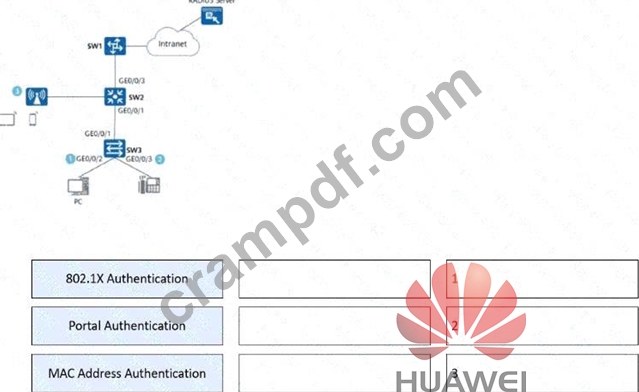
Answer:
Explanation: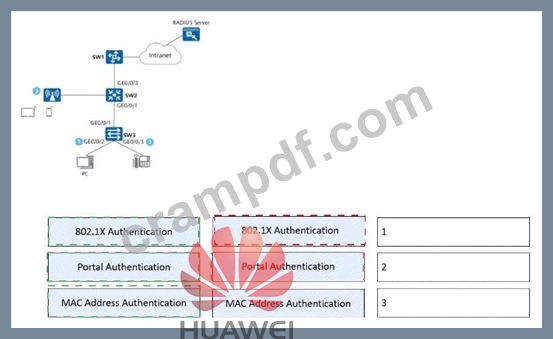
Explanation (Based on HCIP Datacom Campus Network Design)
* Position 1 # 802.1X AuthenticationThis authentication point corresponds to aPC connected to an access switch. PCs typically support 802.1X clients, making802.1X authenticationthe preferred and most secure method for wired user access. It provides strong identity-based access control using a RADIUS server.
* Position 2 # Portal AuthenticationThis point representswireless user access. Portal authentication is commonly used for wireless terminals, especially guest or mobile users, where browser-based authentication is required. Users authenticate through a web page redirected by the access device.
* Position 3 # MAC Address AuthenticationThis point corresponds tonon-802.1X-capable terminals, such as IP phones or printers. These devices cannot initiate 802.1X or Portal authentication, soMAC address authenticationis used to identify and authenticate them based on their MAC addresses.
This authentication deployment aligns with Huawei NAC best practices:
* 802.1X for capable wired terminals
* Portal for wireless or guest access
* MAC authentication for dumb or IoT devices
NEW QUESTION # 47
In Huawei's SD-WAN solution, which of the following technologies can "ensure that the VPN tunnel data encryption algorithm between branches and headquarters is the national standard SM4, meeting the compliance requirements of information security level protection"?
- A. Automatically selects the encryption algorithm; it is not possible to manually specify the national standard encryption algorithm.
- B. Specify the encryption algorithm as SM4 in the SD-WAN tunnel configuration.
- C. Unencrypted tunnel data, relying solely on MPLS label hiding.
- D. It consistently uses international encryption algorithms (such as AES) and does not support Chinese national encryption algorithms.
Answer: B
NEW QUESTION # 48
(The Huawei CloudCampus Solution supports various rate limiting modes for wireless users in small- and medium-sized campus scenarios. Which of the following modes is suitable for refined traffic control of each user?)
- A. ACL-based rate limiting
- B. SSID-based rate limiting
- C. User-based rate limiting
- D. Radio-based rate limiting
Answer: C
Explanation:
In Huawei CloudCampus wireless solutions for small- and medium-sized campus networks,refined traffic controlmeans the ability to precisely limit and manage bandwidth consumption at theindividual user level.
Among the available rate limiting modes,user-based rate limitingis specifically designed to meet this requirement.
User-based rate limiting applies bandwidth control policiesper authenticated user, regardless of which SSID, AP, or radio the user is connected to. This allows administrators to ensure fair bandwidth allocation, prevent a single user from monopolizing wireless resources, and provide differentiated service levels for different user roles, such as employees, guests, or VIP users. This fine-grained control aligns with identity-based access and policy management promoted in HCIP Datacom Campus Network design.
In contrast,SSID-based rate limitingcontrols bandwidth at the service level. It limits total traffic for an entire SSID, which affects all users connected to that SSID collectively, rather than individually.Radio-based rate limitingcontrols bandwidth per radio interface, focusing on wireless resource optimization instead of user- level fairness.ACL-based rate limitingis mainly used for traffic classification and control in wired or advanced scenarios and is not suitable for per-user refined wireless traffic control in CloudCampus WLAN deployments.
Therefore, when the requirement is refined traffic control foreach individual wireless user,user-based rate limitingis the most appropriate and effective option. Hence, the correct answer isA.
NEW QUESTION # 49
(Which of the following is not an advantage of Huawei CloudCampus solution?)
- A. Supports plug-and-play of devices
- B. Unified management of Huawei switches, routers, and storage servers
- C. Supports free mobility
- D. Supports automatic deployment of physical networks
Answer: B
Explanation:
Huawei CloudCampus is an intelligent campus network solution designed to simplify deployment, improve O&M efficiency, and enhance user experience through cloud-based and automated technologies. Its advantages mainly focus onnetwork automation, unified management of campus network devices, and intelligent services, rather than full IT infrastructure management.
Option A is a core advantage of CloudCampus. Through cloud-based controllers and automation technologies, CloudCampus supportsautomatic deployment of physical networks, reducing manual configuration and shortening service rollout time.
Option B is also an important advantage. CloudCampus supportsplug-and-play of devices, where network devices can automatically go online, download configurations, and complete provisioning after being powered on and connected, significantly reducing on-site workload.
Option D is another key feature. Cloud Campus supportsfree mobility, allowing users to roam across different access points or areas while maintaining consistent network access policies and service experience, which is especially important in modern wireless campus environments.
Option C isnot an advantageof the Huawei Cloud Campus solution. Cloud Campus focuses on unified management ofcampus network devicessuch as switches, routers, and wireless devices. It does not provide unified management forstorage servers, which fall outside the scope of campus network management and belong to data center or IT infrastructure management solutions.
Therefore, unified management of Huawei switches, routers, and storage servers is not an advantage of the Cloud Campus solution.
NEW QUESTION # 50
(On a VXLAN-based virtualized campus network, terminals communicate with each other through VXLAN tunnels. When the campus network needs to communicate with external networks, the data must pass through border nodes.)
- A. FALSE
- B. TRUE
Answer: B
Explanation:
Comprehensive and Detailed Explanation (200-250 words):
In a VXLAN-based virtualized campus network, user terminals located in different access locations communicate with each other overVXLAN tunnelsestablished between VXLAN Tunnel Endpoints (VTEPs).
These VXLAN tunnels form the overlay network, which abstracts the physical underlay and enables flexible Layer 2 and Layer 3 connectivity across the campus.
When communication is confined within the virtualized campus network, traffic remains inside the VXLAN overlay and is encapsulated and forwarded between VTEPs. However, when users or services inside the VXLAN network need to accessexternal networks, such as traditional IP networks, the Internet, or data centers that do not support VXLAN, traffic must exit the VXLAN overlay. This function is performed by border nodes.
Border nodes act as the boundary between the VXLAN overlay and non-VXLAN networks. They are responsible for VXLAN encapsulation and decapsulation, routing between VXLAN segments and external networks, and enforcing security and policy controls at the network edge. According to HCIP Datacom Campus Network architecture principles, all traffic entering or leaving the VXLAN-based campus must pass through border nodes to ensure proper routing, policy enforcement, and service control.
Therefore, the statement is TRUE, and option A is correct.
NEW QUESTION # 51
......
H12-841_V1.5 Practice Test Pdf Exam Material: https://www.crampdf.com/H12-841_V1.5-exam-prep-dumps.html
H12-841_V1.5 Answers H12-841_V1.5 Free Demo Are Based On The Real Exam: https://drive.google.com/open?id=1H5tfjBQzSVH08l3WK9hsbHus7a4qy8mF