


[Apr-2026] GES-C01 Dumps With 100% Verified Q&As - Pass Guarantee or Full Refund
Pass Snowflake GES-C01 Exam With Practice Test Questions Dumps Bundle
NEW QUESTION # 118
A Gen AI Specialist is leveraging Snowflake Document AI to extract specific entities and table data from a large and varied collection of documents. They are aware of potential limitations and want to understand the expected outcomes when processing different types of files. Considering a scenario where a Document AI model build is used with the '!PREDICT' method, which of the following statements accurately describe the expected behavior or potential issues based on Document AI's conditions and limitations?
- A. In a table extraction task, if a specific cell (e.g., 'tablellitem') is empty, the resulting JSON will omit the 'value' key for that cell, but will still provide a 'score' indicating the model's confidence that the cell is empty.
- B. If a question for an entity, like 'total_invoice_amount', does not find a corresponding value in a document, the JSON output for will contain a 'value' key with a 'null' string and a 'score' key indicating the model's confidence in the absence of the answer.
- C. Processing a legal contract document that is 130 pages long will likely result in a '_processingErrors' message indicating that the document has too many pages.
- D. A document written entirely in Ukrainian will be processed by Document AI, and the extracted information will be of satisfactory quality due to extensive multilingual support.
- E. If the extracted answer to a question for a single entity (e.g., is very long, it will be automatically truncated to a maximum of 2048 tokens.
Answer: A,C
Explanation:
Option A is correct. Document AI documents must be no more than 125 pages long. A 130-page document would exceed this limit, leading to an error such as 'Document has too many pages. Actual: 150. Maximum: 125.'. Option B is incorrect. If the Document AI model does not find an answer in the document, the model does not return a 'value' key. It only retums the 'score' key, which indicates how confident the model is that the document does not contain the answer. Option C is incorrect. Document AI supports processing documents in English, Spanish, French, German, Portuguese, Italian, and Polish, but notes that results for other languages might not be satisfactory. Ukrainian is not listed among the supported languages. Option D is correct. The sources state that in table extraction, if a cell is empty, the Document AI model does not return a 'value' key but does return the 'score' key, which indicates how confident the model is that the cell is empty. This is illustrated in the example output for 'tablel Itak and 'table21date' . Option E is incorrect. For general entity extraction, the Document AI model returns answers that are up to 512 tokens long (about 320 words) per question. The 2048-token limit applies specifically to answers from the model for table extraction.
NEW QUESTION # 119 
- A. The '_documentMetadata.ocrScore' field will always be present in the root of the JSON output, indicating the confidence in the optical character recognition process for the entire document.
- B. D If 'audit_status' is not found, the 'audit_status' key will be entirely absent from the JSON output for that document.
- C. The 'audit_statuS field, if not found, will appear in the JSON output as Taudit_status": [{"score": 0.0, "value": null}]}'.
- D. For successfully extracted entities like 'net_profit' , the JSON output typically includes an array of objects, each containing both 'score' and 'value' keys.
- E. If a 'quantity' cell in is empty, the JSON output for that specific cell will include a 'score' key but omit the 'value' key.
Answer: A,D,E
Explanation:
Option B is correct because if a table cell is empty, the Document AI model will not return a 'value' key for that cell, but it will still return the 'score' key, indicating its confidence that the cell is empty. Option C is correct because for successfully extracted entities, the JSON output for fields like 'net_profit typically includes an array of objects, where each object contains both a 'score' and a 'value' key. Option D is correct because the 'ocrScore' field within '_documentMetadata' is always present in the root of the JSON output, specifying the confidence score for the optical character recognition process for the document. Option A is incorrect; when an entity like 'audit_statuS is not found, the model omits the 'value' key, rather than setting it to 'null'. Option E is incorrect because if the Document AI model does not find an answer for an entity, it still returns the key for that entity but omits the 'value' key, while retaining the 'score' key to indicate confidence that the answer is not present. For example, the "buyer_name' field in Source demonstrates this by showing a 'score' but no 'value'
NEW QUESTION # 120
A data scientist is tasked with improving the accuracy of an LLM-powered chatbot that answers user questions based on internal company documents stored in Snowflake. They decide to implement a Retrieval Augmented Generation (RAG) architecture using Snowflake Cortex Search. Which of the following statements correctly describe the features and considerations when leveraging Snowflake Cortex Search for this RAG application?
- A. To create a Cortex Search Service, one must explicitly specify an embedding model and manually manage its underlying infrastructure, similar to deploying a custom model via Snowpark Container Services.
- B. Cortex Search automatically handles text chunking and embedding generation for the source data, eliminating the need for manual ETL processes for these steps.
- C. Enabling change tracking on the source table for the Cortex Search Service is optional; the service will still refresh automatically even if change tracking is disabled.
- D. For optimal search results with Cortex Search, source text should be pre-split into chunks of no more than 512 tokens, even when using models with larger context windows like

- E. The

Answer: B,D,E
Explanation:
Option A is correct because Cortex Search is a fully managed service that gets users started with a hybrid (vector and keyword) search engine on text data in minutes, without needing to worry about embedding, infrastructure maintenance, or index refreshes. Option B is incorrect because Cortex Search is a fully managed service; users do not need to manually manage the embedding model infrastructure. A default embedding model is used if not specified. Option C is correct because, for best search results with Cortex Search, Snowflake recommends splitting text into chunks of no more than 512 tokens, as smaller chunks typically lead to higher retrieval and downstream LLM response quality, even with models that have larger context windows. Option D is correct because the SNOWFLAKE.CORTEX.SEARCH_PREVIEW' function allows users to test the search service to confirm it is populated with data and serving reasonable results for a given query. Option E is incorrect because change tracking is required on the source table for the Cortex Search Service to function correctly and reflect updates to the base data.
NEW QUESTION # 121
A data science team is fine-tuning a Snowflake Document AI model to improve the extraction accuracy of specific fields from a new type of complex legal document. They are consistently observing low confidence scores and inconsistent 'value' keys for extracted entities, even after initial training. Which two of the following best practices should the team follow to most effectively improve the model's extraction accuracy and confidence for this complex document type?
- A. Actively involve subject matter experts (SMEs) or document owners throughout the iterative process to help define data values, provide annotations, and evaluate the model's effectiveness.
- B. Set the 'temperature' parameter to a higher value (e.g., 0.7) during '!PREDICT calls to encourage more creative and diverse interpretations by the model.
- C. Prioritize extensive prompt engineering by creating highly detailed and complex questions with intricate logic to guide the LLM's understanding of the extraction task.
- D. Ensure the training dataset used for fine-tuning includes diverse documents representing various layouts, data variations, and explicit examples of 'NULL' values or empty cells where appropriate.
- E. Limit the fine-tuning training data exclusively to perfectly formatted and clean documents to ensure the model learns from ideal examples without noise.
Answer: A,D
Explanation:
To improve Document AI model training, it is crucial to ensure that the documents uploaded for training represent a real use case and that the dataset consists of diverse documents in terms of both layout and data. If all documents contain the same data or are always presented in the same form, the model might provide incorrect results. For table extraction, it is vital that enough data is used to train the model to include values and maintain order. Therefore, ensuring a diverse training dataset (Option B) is a key best practice. Additionally, Subject Matter Experts (SMEs) and document owners are crucial partners in understanding and evaluating the model's effectiveness in extracting the required information. Their involvement in defining data values, providing annotations, and evaluating results will significantly improve accuracy (Option C). Option A is not a best practice; it's recommended to keep questions as encompassing as possible and rely on training with annotations rather than complex prompt engineering, especially for document variability. Option D is incorrect; a higher 'temperature' value increases the randomness and diversity of the model's output, which is generally undesirable for accurate data extraction where deterministic results are preferred. For most consistent results, 'temperature' should be set to 0. Option E is incorrect because training on a restricted set of perfectly formatted documents can lead to a model that performs poorly on real-world, varied documents; diversity in training data is essential.
NEW QUESTION # 122
An administrator has configured the 'CORTEX MODELS ALLOWLIST parameter to only permit the 'mistral-large? model at the account level. A user with the role, which has been granted 'SNOWFLAKE.CORTEX USER and 'SNOWFLAKE."CORTEX- MODEL-ROLE-LLAMA3.1-70B"', attempts to execute several queries. Which of the following queries will successfully execute?
- A.

- B.

- C.

- D.

- E.

Answer: A,C
Explanation:
Option A is correct because the 'MISTRAL-LARGE2' model is explicitly included in the account-level , allowing the 'AI_COMPLETE' function to be used with it. Option B is correct because the user's 'PUBLIC' role has been granted the application role , which provides access to the 'LLAMA3.1- 70B' model object in 'SNOWFLAKE.MODELS'. When a model name is provided as a string argument, Cortex first checks if it's an identifier for a schema-level model object and applies RBAC, overriding the allowlist for that specific object. Option C is incorrect because 'llama3.1-70b' as a plain model name is not in the 'CORTEX MODELS ALLOWLIST' , and while the user has RBAC access to the model 'object' , a plain string name will be matched against the allowlist if it fails to match a model object by that plain name. Option D is incorrect as 'snowflake-arctic' is neither in the 'CORTEX MODELS ALLOWLIST nor does the user have a specific application role for it, causing the query to fail. Option E is incorrect because 'ALTER ACCOUNT operations, such as modifying , require the 'ACCOUNTADMIN' role, not the SPUBLIC' role.
NEW QUESTION # 123
A Snowflake administrator is tasked with monitoring and optimizing costs for various Gen AI applications leveraging Snowflake Cortex LLM functions. They need to generate a report detailing token consumption for individual API calls to identify high-usage patterns and specific models. Which of the following Snowflake account usage views or methods would provide the most granular insights into prompt, completion, and guardrail token usage for Cortex LLM function calls?
- A. Option A
- B. Option B
- C. Option E
- D. Option C
- E. Option D
Answer: B,E
Explanation:
NEW QUESTION # 124 
database role. Which of the following 'privileges directly related to the virtual warehouse or task execution' are required for the process invoices_task' to successfully execute the Document AI '!PREDICT' method? (Select ALL that apply.)
- A.

- B.

- C.

- D.

- E.

Answer: A,B,E
Explanation:
For successful Document AI operations, including the '!PREDICT method, and for a Snowflake task to run, several privileges are required. The role must have USAGE on the database, 'USAGES on the schema, 'USAGE' on the virtual warehouse, and 'OPERATE' on the virtual warehouse. Since the context is an automated task, 'EXECUTE TASK ON ACCOUNT is also a mandatory privilege for the task's owning role to execute the task. Therefore: - Option B (USAGE ON WAREHOUSE) is required to use the virtual warehouse for computation. - Option C COPERATE ON WAREHOUSE) is required to manage the operational state (e.g., start/stop) of the virtual warehouse. - Option E ( ' EXECUTE TASK ON ACCOUNT) is required for the Snowflake task to execute. - Option A CUSAGE ON SCHEMA') is a general prerequisite for interacting with objects (like the model build) within that schema, but the question specifically asks for privileges 'directly related to the virtual warehouse or task execution'. While functionally necessary for the overall process, it's not a privilege the warehouse or task execution itself. - Option D (READ ON STAGE) is necessary for the '!PREDICT method to access documents from the stage, but similar to Option A, it is not a privilege 'directly related to the virtual warehouse or task execution' based on the specific wording of the question.
NEW QUESTION # 125
A team is developing a critical business intelligence application that leverages Snowflake Cortex Analyst to provide natural language querying capabilities over complex structured dat a. To minimize operational costs while maintaining high accuracy, which of the following strategies are most effective for optimizing the cost efficiency of the Cortex Analyst service?
- A. Leveraging Cortex Search Services integration within the semantic model to improve literal value matching, thereby reducing the need for Cortex Analyst to perform expensive fuzzy string matching or re-prompt the user.
- B. Configuring a custom instruction with a short, precise task description to reduce the input token count for the LLMs orchestrating SQL generation.
- C. Implementing a comprehensive Verified Query Repository (VQR) to guide Cortex Analyst towards pre-validated SQL queries for common questions, which ensures predictable execution and reduces LLM inference iterations.
- D. Optimizing the semantic model YAML file by reducing the number of logical tables and columns to decrease the metadata processed by Cortex Analyst's LLMs per message.
- E. Using a smaller, less capable LLM as the underlying summarization agent for multi-turn conversations to reduce token processing costs, even if it slightly degrades conversational context.
Answer: A,C
Explanation:
Option B is correct because a Verified Query Repository (VQR) helps Cortex Analyst leverage pre-validated SQL for similar questions, improving accuracy and potentially reducing the number of LLM inference calls or complex reasoning steps required for SQL generation, thus making usage more efficient and reducing cost associated with less optimal LLM calls. Option D is correct because integrating Cortex Search Services improves literal search, helping Cortex Analyst find exact literal values needed for SQL queries more accurately and efficiently, which can reduce ambiguity and the need for multiple LLM iterations or incorrect queries, ultimately leading to more cost-effective message processing. Option A is incorrect: While using a smaller LLM might seem to save cost, Llama 3.1 70B was specifically chosen as the summarization agent for multi-turn conversations in Cortex Analyst due to its higher accuracy in rephrasing questions and avoiding errors, implying that a less capable model would degrade performance and potentially lead to more (and thus more expensive) overall messages to achieve a correct answer. The cost for Cortex Analyst is per message, not per token for this component. Option C is incorrect. While a well- scoped semantic model is recommended for accuracy, the sources do not explicitly state that reducing the number of logical tables and columns 'directly' reduces the per-message cost of Cortex Analyst, which is fixed per message. The impact would be indirect through improved accuracy or reduced processing complexity, but not a direct cost reduction based on metadata size for the fixed per-message billing. Option E is incorrect. Cortex Analyst cost is based on the number of messages, not the token count of prompts. While good prompt engineering (like concise custom instructions) is generally good practice, it does not directly reduce the per-message cost of Cortex Analyst as it would for token- based LLM calls.
NEW QUESTION # 126
A data analytics team is building a Retrieval Augmented Generation (RAG) application to provide contextual answers from a vast repository of internal documents stored in Snowflake. They are evaluating different strategies for generating and retrieving text embeddings to optimize the overall RAG pipeline's performance and relevance. Which of the following statements accurately describe performance considerations related to embedding generation and retrieval in this RAG context? (Select all that apply)
- A. Option A
- B. Option B
- C. Option E
- D. Option D
- E. Option C
Answer: B,E
Explanation:
For optimizing RAG pipeline performance and relevance: ' This statement is incorrect. Snowflake's documentation explicitly recommends splitting text into smaller chunks (no more than 512 tokens) for Cortex Search to achieve optimal retrieval and downstream LLM response quality. This holds true even with models that have larger context windows like 'snowflake-arctic-embed-l-v2.0-8k' , because smaller chunks lead to more precise retrieval. * **B:** Deploying custom models like a Hugging Face 'sentenceTransformeN on Snowpark Container Services (SPCS) with GPU compute pools (e.g., *GPU or *GPU NV_M') is optimized for intensive GPU usage scenarios like LLMs/VLMs. This can provide lower latency and higher throughput for embedding generation in very high-volume, custom scenarios, offering more control than managed functions. ' This statement is correct. Snowflake's documentation clearly states that for best search results with Cortex Search, it is recommended to split the text in the search column into chunks of no more than 512 tokens. This strategy typically results in higher retrieval and better quality responses from downstream LLMs. * This statement is incorrect. Snowflake explicitly advises executing queries that call Cortex AI SQL functions (including ' EMBED_TEXT') with a *smaller* warehouse (no larger than MEDIUM), as larger warehouses do not increase performance for these specific functions. * *E:" This statement is incorrect. Cortex Search powers RAG applications by leveraging *semantic search*, which combines both vector and keyword search capabilities, to provide customized, contextualized responses. Relying solely on keyword search would generally yield less contextual relevance for LLM responses than a hybrid approach.
NEW QUESTION # 127
A data engineer has successfully experimented with a prompt and various model settings in the Snowflake Cortex Playground for a text classification task using the mistral-large2 model and Cortex Guard. They now want to operationalize this solution within their Snowflake environment. Which of the following statements correctly describe capabilities or considerations when moving from the Cortex Playground to a production pipeline?
- A. The exported SQL query, when used with dynamic tables, supports incremental refresh for efficient processing of new data without recomputing the entire table.
- B. For continuous processing of new data, the exported SQL query can be automated using
- C. To filter unsafe LLM responses in production, the Cortex Guard option, which is built with Meta's Llama Guard 3, must be explicitly enabled in the COMPLETE function's options argument.
- D. If the mistral-large2 model is not natively available in the target production region, cross-region inference must be enabled by setting the CORTEX_ENABLED_CROSS REGION parameter.
- E. The Playground allows exporting the exact SQL query with all defined model settings, including temperature and Cortex Guard enablement, for direct use in a Snowflake worksheet or task.
Answer: B,C,D,E
Explanation:
The Cortex Playground offers the capability to export the exact SQL query, including specified settings like 'temperature' and whether Cortex Guard is enabled. This exported SQL can be directly used in Snowflake worksheets, notebooks, or automated via streams and tasks for continuous execution. Cortex Guard is a feature of the (or ' COMPLETE) function, built with Meta's Llama Guard 3, and needs to be explicitly enabled using the 'guardrails' option to filter unsafe responses. Automation with streams and tasks is a valid approach for document processing pipelines using 'PREDICT' and 'COMPLETE' functions. If a model like 'mistral-large? is not natively available in a specific Snowflake region, cross-region inference must be enabled for Cortex LLM functions. However, dynamic tables do not currently support incremental refresh when using the 'COMPLETE' function.
NEW QUESTION # 128
A data application developer is using the Snowflake Cortex COMPLETE function to power a multi-turn conversational AI application. They want to ensure responses are creative but not excessively long, adhere to a specific JSON structure, and are filtered for safety. Given the following SQL query snippet, which statements accurately describe the impact of the specified options?
- A. The

- B. Setting

- C. For a multi-turn conversation, previous user prompts and model responses should be passed in the

- D. Including a
- E. The

Answer: A,D,E
Explanation:
Option A is incorrect because a higher temperature, such as 0.8, controls the randomness of the output by influencing which possible token is chosen at each step, resulting in more diverse and random output, not deterministic and focused. Option B is correct because the 'max_tokens' option sets the maximum number of output tokens in the response, and small values can result in truncated responses. Option C is correct because the 'guardrails: TRUE option enables Cortex Guard to filter potentially unsafe and harmful responses from a language model. Option D is correct because AI_COMPLETE Structured Outputs allows you to supply a JSON schema that completion responses must follow, and every model supported by AI_COMPLETE supports structured output. Option E is incorrect because to provide a stateful conversational experience, all previous user prompts and model responses should be passed in the 'prompt_or_history' array, but the number of tokens processed increases for each round, and costs increase proportionally. The 'COMPLETE' function is the older version of 'AI_COMPLETE'.
NEW QUESTION # 129
A multi-national corporation uses Snowflake across several AWS regions. Their primary operational Snowflake account is in AWS US East (Ohio), but they need to leverage a specific AI_COMPLETE model, llama4-maverick, which is natively available in AWS US East 1 (N. Virginia) but not in US East (Ohio). To address this, the Snowflake administrator enables cross-region inference for their US East (Ohio) account.
- A. Option A
- B. Option E
- C. Option C
- D. Option D
- E. Option B
Answer: A,D
Explanation:
Option A is correct because the account parameter is used to enable cross-region inference. Setting it CORTEX_ENABLED_CROSS_REGION to 'Aws us' would permit inference requests to be processed in any AWS US region, such as N. Virginia, from a local AWS US region like Ohio. Option B is incorrect because user inputs, service generated prompts, and outputs are explicitly not stored or cached during cross-region inference. Option C is incorrect as cross-region inference is not supported in U.S. SnowGov regions for either inbound or outbound inference requests. Option D is correct because the sources indicate that is natively available in AWS US East 1 (N. Virginia) and is supported AI_COMPLETE (llama4-maverick) for cross-region inference within AWS US regions, making it a valid target for the account in US East (Ohio). Option E is incorrect because latency between regions depends on the cloud provider infrastructure and network status, and Snowflake recommends testing specific use cases with cross-region inference enabled.
NEW QUESTION # 130
A development team is building a RAG application in Snowflake Cortex that needs to extract high-fidelity text and layout from a collection of technical documentation PDFs stored in an internal stage to power semantic search and LLM responses. They want to ensure proper context retrieval for complex user queries. Given this scenario, which of the following actions or statements are crucial for effectively leveraging AI_PARSE_DOCUMENT to optimize the RAG pipeline?
- A. Option A
- B. Option B
- C. Option E
- D. Option D
- E. Option C
Answer: B,E
Explanation:
NEW QUESTION # 131
A data architect is integrating Snowflake Cortex LLM functions into various data enrichment pipelines. To ensure optimal performance, cost-efficiency, and accuracy, which of the following are valid best practices or considerations for these pipelines?
- A. For data enrichment involving classification with 'AI_CLASSIFY' , using descriptive and mutually exclusive categories in plain English, along with an optional clear task description, can significantly improve classification accuracy.
- B. To manage costs effectively for LLM functions like SAI COMPLETE in a pipeline, always use the largest available warehouse size (e.g., 6XL Snowpark- optimized) to maximize throughput, as this directly reduces the overall token processing time and cost.
- C. For tasks requiring deterministic JSON outputs, explicitly specifying a JSON schema using the 'response_format' argument with 'AI COMPLETE is crucial, and for OpenAI (GPT) models, including the 'required' field and setting 'additionalPropertieS to 'false' in every node of the schema is a mandatory requirement.
- D. When extracting specific entities from documents using SAI EXTRACT or '!PREDICT , it is often more effective to fine-tune a Document AI model for complex or varied document layouts rather than relying solely on extensive prompt engineering for zero-shot extraction.
- E. When performing sentiment analysis on customer feedback using 'AI_SENTIMENT, it's best practice to pass detailed, multi-turn conversation history to the function to enhance accuracy, similar to how 'AI_COMPLETE handles conversational context.
Answer: A,C,D
Explanation:
Option A is correct. For extracting information from documents with complex or varied layouts, fine-tuning a Document AI model can significantly improve results compared to relying solely on zero-shot extraction and extensive prompt engineering. Document AI provides both zero-shot extraction and fine-tuning capabilities, with fine-tuning recommended to improve results on specific document types. Option B is correct. To ensure 'AI_COMPLETE (or 'COMPLETE) returns responses in a structured JSON format, it is essential to specify a JSON schema using the 'response_format' argument. For OpenAl (GPT) models, specific requirements include setting 'additionalPropertieS to 'false' in every node and ensuring the 'required' field lists all property names. Option C is incorrect. Snowflake explicitly recommends executing queries that call Cortex AISQL functions (such as 'AI COMPLETES) using a smaller warehouse, no larger than MEDIUM. Using larger warehouses does not increase performance for these functions but will incur unnecessary compute costs. The LLM inference itself is managed by Snowflake, and its performance isn't directly scaled by warehouse size in the same way as traditional SQL queries. Option D is incorrect. 'AI_SENTIMENT (and 'SENTIMENT) is a task-specific function designed to return a sentiment score for a given English-language text. Unlike 'AI_COMPLETE (or 'COMPLETE'), which supports multi-turn conversations by passing conversation history for a stateful experience, SAI SENTIMENT processes individual text inputs and is not designed to leverage multi-turn context in the same way for sentiment analysis. Option E is correct. For classification tasks using 'AI_CLASSIFY (or 'CLASSIFY TEXT), best practices include using plain English for the input text and categories, ensuring categories are descriptive and mutually exclusive, and adding a clear 'task_description' when the relationship between input and categories is ambiguous. These guidelines significantly improve classification accuracy.
NEW QUESTION # 132
A data engineer is setting up a Document AI pipeline to extract information from scanned invoices stored in an internal stage named 'invoice_stage'. They have created the stage using 'CREATE STAGE and uploaded several PDF documents. However, when attempting to run the extraction query, they encounter an error message: 'File extension does not match actual mime type. Mime- Type: application/octet-stream'. Additionally, they anticipate a privilege issue might arise for pipeline automation. Which of the following conditions must be met to resolve the current error and ensure proper setup for Document AI extraction and subsequent pipeline creation?
- A. Option A
- B. Option E
- C. Option D
- D. Option B
- E. Option C
Answer: A,E
Explanation:
NEW QUESTION # 133
An ML engineer has developed a custom PyCaret classification model and wants to deploy it to Snowpark Container Services (SPCS) for inference using the Snowflake Model Registry. The model requires specific versions of pycaret' , 'scipy', and 'joblib'. The engineer also wants to make the service accessible via an HTTP endpoint. Which of the following Model Registry and service creation steps are 'most appropriate' for the ML engineer? (Select all that apply.)
- A.

- B.

- C.

- D. Opt for warehouse deployment instead of SPCS, as PyCaret is not natively supported by Snowflake and managing its dependencies in SPCS would be overly complex compared to a warehouse.
- E.

Answer: B,C,E
Explanation:
Option A is correct. When bringing an unsupported model type, such as PyCaret, you must define a 'ModelContext' that refers to the serialized model file (e.g., a pickled file). Option B is incorrect. For models deployed to Snowpark Container Services, 'conda_dependencies' are, by default, obtained from 'conda-forge' , not the Snowflake Anaconda channel, which is used for warehouse deployments. Therefore, relying on the Snowflake Anaconda channel for SPCS deployment is incorrect. Option C is correct. While 'conda_dependencies' can be used for SPCS (resolved from 'conda-forge'), 'pip_requirementS are often a more direct and reliable way to specify dependencies for custom or less common third-party Python packages, ensuring they are pulled directly from PyPI if not available in 'conda-forge' . The PyCaret example in the sources, while using 'conda_dependencies' , represents a specific case, and for broader 'custom third-party packages', pip is a strong choice. Option D is correct. To make the deployed service accessible via an HTTP endpoint, must be set to 'True'. Additionally, 'gpu_requests = (or the appropriate number of GPUs) is essential when deploying a model to a GPU compute pool to ensure it leverages the GPU resources for inference. Option E is incorrect. Snowpark Container Services is specifically designed to ease the restrictions of warehouse deployment, allowing for the use of any packages (including PyPl) and enabling large models to run on distributed clusters of GPUs, which is ideal for this scenario.
NEW QUESTION # 134
A development team is preparing to deploy a new Retrieval-Augmented Generation (RAG) application written in Python. They intend to use Snowflake AI Observability to capture detailed logs and traces for debugging and performance analysis. Which of the following configurations are essential prerequisites for enabling this logging capability effectively?
- A. Option B
- B. Option E
- C. Option A
- D. Option D
- E. Option C
Answer: A,B,C,E
Explanation:
NEW QUESTION # 135
A data engineering team is building a pipeline in Snowflake that uses a SQL task to call various Snowflake Cortex LLM functions (e.g., AI_COMPLETE, AI EMBED) on large datasets of customer interaction logs. The team observes fluctuating costs and occasional query failures, which sometimes halt the pipeline. To address these issues and ensure an efficient, robust, and monitorable pipeline, which of the following actions or considerations are essential? (Select all that apply.)
- A. Option B
- B. Option E
- C. Option A
- D. Option D
- E. Option C
Answer: A,B,C
Explanation:
A). "Correct." The 'TRY function is designed to perform the same operation as but returns 'NULL ' instead of raising an error when the LLM operation cannot be performed. This is critical for building robust data pipelines, as it prevents pipeline halts due to transient or specific LLM failures, allowing for more resilient data processing. B. ' The view provides detailed information on token consumption and credit usage for Snowflake Cortex LLM functions. Monitoring this view is essential for understanding cost drivers and optimizing expenditure within AI pipelines. C. "Incorrect." Snowflake recommends executing queries that call Cortex AISQL functions with a smaller warehouse (no larger than MEDIUM), as larger warehouses do not necessarily increase performance but can lead to unnecessary costs. The LLM inference itself runs on Snowflake-managed compute, not solely on the user's virtual warehouse compute size. D. ' Setting the 'temperature' parameter to 0 makes the LLM's output more deterministic and focused. While this can be beneficial for consistency in certain tasks, it does not directly minimize token usage. Token usage is primarily determined by the length of the input prompt and the length of the generated output, which can vary regardless of 'temperature'. E. "Correct." Encapsulating complex and potentially lengthy prompt logic within a UDF CUSER DEFINED FUNCTION') makes the prompts more manageable, reusable, and easier to integrate programmatically into SQL statements within a data pipeline. This improves code organization and maintainability.
NEW QUESTION # 136
A data pipeline processes thousands of scanned legal contracts daily using a Document AI model via the '!PREDICT function. The process involves fetching presigned URLs for documents from an internal stage using 'GET PRESIGNED URL'. Recently, the pipeline has started failing intermittently, returning the error:
The data engineering team confirms network connectivity and privileges are stable. Which of the following is the most likely cause of this issue?
- A. The internal stage is not configured with
- B. The
- C. The Document AI model build has not been published to the production environment.
- D. The virtual warehouse assigned to the Document AI pipeline is undersized (e.g., X-Small), leading to slow processing that indirectly causes URL expiration.
- E. The documents contain handwritten annotations, which Document AI struggles to process effectively.
Answer: B
Explanation:
The error message 'Received HTTP 403 response for presigned URL. URL may be expired.' is a direct indication that the presigned URL, generated by the function, has exceeded its default expiration time before the Document AI model could complete processing the document. The GET PRESIGNED URL' function has a default expiration time of 60 minutes. If the query processing time for a batch of documents, or any delay in the pipeline, exceeds this window, the URLs become invalid. Option A would typically result in errors related to file format or mime type if not using 'SNOWFLAKE SSE' for an internal stage. Option B would prevent the '!PREDICT function from executing successfully, likely with a different error message indicating the model build is not ready or accessible. Option D describes a potential performance bottleneck, but the immediate cause of a '403 URL expired' error is the time limit, regardless of underlying warehouse efficiency. Option E would affect the accuracy of extraction, not cause a presigned URL access error.
NEW QUESTION # 137
A data analytics team is building a self-service analytics application using Snowflake Cortex Analyst to allow business users to query sales data with natural language. They are defining a semantic model in YAML to ensure accurate text-to-SQL generation. Which of the following is the most crucial aspect of the semantic model's configuration for Cortex Analyst to effectively translate natural language into SQL for structured data?
- A. Configuring the 'base_table' parameter to directly reference a dynamic table, ensuring real-time data ingestion and processing before SQL generation.
- B. Defining a comprehensive 'verified_queries' section with a high volume of example natural language questions and their exact SQL translations to handle all potential user queries.
- C. Providing detailed 'name', 'description' , and 'synonyms' for logical tables, dimensions, and facts to bridge the gap between business terminology and the underlying database schema.
- D. Specifying a dedicated 'CORTEX SEARCH SERVICE for every dimension to pre-compute all possible literal values, optimizing response time.
- E. Utilizing advanced data types like 'VARIANT' and 'OBJECT for all dimensions to accommodate semi-structured data without complex transformations.
Answer: C
Explanation:
Option C is correct because the primary purpose of a semantic model in Cortex Analyst is to provide semantic information about your data, bridging the gap between business users' natural language and the technical database schema. This includes using descriptive names, synonyms, and descriptions for logical tables, dimensions, and facts, which is essential for Cortex Analyst to reliably generate accurate SQL from natural language questions. Option A is incorrect; while Cortex Search Services can improve literal matching for dimensions, it's an enhancement and not the most crucial foundational aspect of the semantic model for general text-to-SQL translation, nor is it required for 'every' dimension. Option B is incorrect because while 'verified_queries' improve accuracy for similar questions, a high volume of examples for 'all' potential queries is not feasible or the most crucial initial configuration; the core mapping (Option C) is more fundamental. Option D is incorrect as the 'base_table' must refer to a physical table or view, not directly to a dynamic table. Furthermore, Cortex functions do not support dynamic tables directly. Option E is incorrect because 'VARIANT, 'OBJECT, 'GEOGRAPHY , and 'ARRAY data types are explicitly not supported for dimension, fact, or metric columns in a semantic model.
NEW QUESTION # 138
A development team is evaluating Snowpark Container Services (SPCS) for deploying various AI/ML workloads, including custom LLMs and GPU-accelerated model training. They need to understand its core benefits and operational characteristics compared to traditional container orchestration platforms. Which of the following statements accurately describe the benefits and/or operational characteristics of Snowpark Container Services for deploying third-party models and AI applications?
- A. Snowpark Container Services ensures that data remains within Snowflake's security and governance boundaries, eliminating the need to move data out of the environment for processing.
- B. SPCS supports both long-running services (e.g., web applications) and finite-lifespan job services (e.g., GPU-accelerated machine learning model training).
- C. SPCS primarily supports applications written in Python and Java, with limited experimental support for other programming languages.
- D. Compute clusters within SPCS are designed to auto-scale dynamically based on workload demand, automatically adjusting the number of instances.
- E. SPCS provides a fully managed OCI runtime execution environment, allowing users to run containerized workloads directly within Snowflake without managing underlying Docker or Kubernetes infrastructure.
Answer: A,B,E
Explanation:
Option A is correct. Snowpark Container Services is designed to run containerized workloads directly within Snowflake, ensuring that data does not need to be moved out of the Snowflake environment for processing, thereby maintaining security and governance. Option B is correct. SPCS is a fully managed container offering that provides an OCI runtime execution environment optimized for Snowflake, abstracting away the complexities of traditional container orchestration platforms like Docker or Kubernetes. Option C is incorrect. Snowpark Container Services allows application code to be written in 'any language' (e.g., C++) and to use 'any libraries', not just Python and Java. Option D is correct. SPCS supports long-running services, which explicitly stop when no longer needed (like web services), and job services, which have a finite lifespan and run to completion (like GPU-accelerated ML model training). Option E is incorrect. The size of compute clusters in Snowpark Container Services does not auto-scale; users must manually alter the number of instances at runtime using commands like 'ALTER SERVICE MIN INSTANCES ='.
NEW QUESTION # 139
A data engineer is developing an AI-infused data pipeline in Snowflake Notebooks to analyze Federal Reserve Meeting Minutes and official Statements, which are initially in PDF format. The goal is to determine the FED's stance on interest rates (hawkish, dovish, or neutral) and the reasoning for each ingested PDF using an LLM. The pipeline needs to automate data ingestion, text extraction, LLM inference, and store the results in a Snowflake table. Which sequence of operations and Snowflake features is most appropriate for building this pipeline within Snowflake?
- A. Scrape PDF data from an external website, load unstructured PDF files to an internal stage, then use a 'UDE to parse raw text from PDFs and a separate UDF' ('GENERATE_PROMPT) to encapsulate a custom prompt. Finally, use a 'TASK' to automate the process, calling Snowflake's function with the custom prompt at the point of ingestion to generate the sentiment signal and reasoning.
- B. Directly ingest PDF documents into a 'VARIANT column in a Snowflake table. Then, use the SQL function in 'OCR mode to extract text and layout. The extracted text is then passed to 'SNOWFLAKE.CORTEX.CLASSIFY TEXT to determine the sentiment, and the results are stored in a new table.
- C. Load unstructured PDF files into an internal stage. Use a stored procedure to download new PDFs from the FOMC website. Leverage Snowpark Container Services to deploy a fine-tuned open-source LLM (e.g., Llama 2) for text extraction and sentiment analysis, and orchestrate the pipeline with ' Dynamic TableS for continuous updates.
- D. Scrape data from an external website directly into a Snowflake table using an 'EXTERNAL FUNCTION'. Then, apply 'SNOWFLAKE.CORTEX.EXTRACT ANSWER with a question like 'What is the FED's stance?' and 'SNOWFLAKE.CORTEX.SUMMARIZE' for reasoning to enrich the table. Automate this using 'STREAMS' and 'TASKS.
- E. Ingest PDF documents into a directory table. Use 'Document AI' C!PREDICT') to extract specific entities and tables from the PDFs into structured JSON. Then, create a 'STREAM' on the stage and a 'TASK' to continuously process new documents, extracting information and potentially performing additional sentiment analysis with another LLM.
Answer: A,E
Explanation:
Option A is correct. This option directly aligns with the 'AI-Infused Pipelines with Snowflake Cortex' blog post. It describes scraping data, loading to an internal stage, using a stored procedure to download new PDFs, and 'UDFS for parsing text and generating prompts. It explicitly mentions using 'Snowflake's TRY_COMPLETE function for LLM inference with a custom prompt at ingestion, all automated with 'Streams' and 'Tasks'. Option B is incorrect. PARSE DOCUMENT in 'OCR mode extracts text but does not preserve layout and primarily focuses on text and layout extraction, not directly sentiment analysis or complex reasoning. While 'CLASSIFY _ TEXT (or can classify text, 'AI PARSE DOCUMENT is for extracting text and layout from documents, not direct ingestion into a 'VARIANT' column for text extraction via 'OCR mode. is a Cortex AI SQL function, typically used on files stored in stages. Option C is incorrect. While Snowpark Container Services can host LLMs and Dynamic Tables can automate updates, using an external LLM for text extraction when 'Document AI' or are available for native PDF processing is not the most direct approach. Additionally, 'Dynamic Tables' do not support incremental refresh with 'COMPLETE , and the prompt generation and sentiment analysis would still need to be explicitly defined. Option D is incorrect. Directly scraping into a Snowflake table with an 'EXTERNAL FUNCTION' isn't covered as the primary ingestion method for PDFs in the context of LLMs for sentiment. 'EXTRACT ANSWER and 'SUMMARIZE are task-specific Cortex functions, but the core task is a multi-step pipeline for PDF content analysis, which would be better served by a robust document processing solution. The focus of the pipeline example is on PDFs, not general website scraping directly to a table for immediate LLM application. Also, 'EXTRACT_ANSWER is for extracting a specific answer, while the sentiment is a classification. Option E is correct. This option uses 'Document AI' , which is specifically designed to extract structured information (entities, tables) from unstructured documents like PDFs using 'Arctic-TILT'. It explicitly mentions creating a 'STREAM' on a stage and a "TASK' for continuous processing, which is a standard pattern for Document AI pipelines. This approach directly handles the PDF extraction and structuring into JSON, which can then be further processed for sentiment analysis or reasoning if needed. The output JSON from '!PREDICT includes various extracted fields and can be parsed.
NEW QUESTION # 140
A data engineer is tasked with implementing a product recommendation system in Snowflake. They have pre-computed product embeddings and want to find similar items using VECTOR_COSINE_SIMILARITY They are evaluating options for interacting with this function. Which of the following statements is TRUE regarding the use of VECTOR_COSINE_SIMILARITY and Snowflake's VECTOR data type?
- A. A column defined as

- B. Direct comparison operators like

- C. The

- D. The maximum dimension supported by the
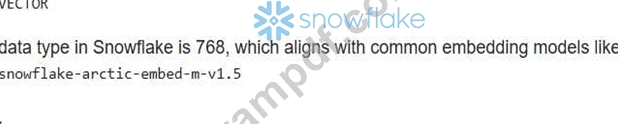
- E.

Answer: E
Explanation:
Option A is incorrect because the Snowpark Python library does not directly support the
data type in Snowflake is 4096, not 768. Option D is incorrect. Direct vector comparisons using operators like
columns and is supported when using the Snowflake Python Connector.
NEW QUESTION # 141
A data science team is implementing a large-scale Retrieval Augmented Generation (RAG) application on Snowflake, using 'SNOWFLAKE.CORTEX.EMBED TEXT 1024' to process millions of customer support tickets for semantic search. The goal is to achieve high retrieval quality and manage costs effectively. Which of the following are recommended practices and accurate cost/performance considerations when leveraging 'EMBED TEXT 1024' in this scenario? (Select all that apply)
- A. The function should be called using 'TRY_COMPLETE instead of directly to handle potential errors gracefully and avoid incurring costs for failed operations.
- B. To minimize compute costs, the team should use a Snowpark-optimized warehouse for operations, as it is specifically designed for ML workloads.
- C. Models for such as 'snowflake-arctic-embed-l-v2.0' and 'multilingual-e5-large' , are billed at 0.05 Credits per one million input tokens processed.
- D. For 'EMBED_TEXT 1024' , billing is based on both input and output tokens, encouraging brevity in generated embeddings to control costs.
- E. Even with models like 'snowflake-arctic-embed-l-v2.0-8k' which have a large context window (8192 tokens), splitting customer support tickets into chunks of no more than 512 tokens is recommended for optimal RAG retrieval quality.
Answer: C,E
Explanation:
Option C is correct. For best search results with Cortex Search and RAG, Snowflake recommends splitting the text into chunks of no more than 512 tokens. This practice typically results in higher retrieval and downstream LLM response quality, even for models with larger context windows like 'snowflake-arctic-embed-l-v2.0-8k' (8192 tokens). Option E is correct. For functions, only 'input tokens' are counted towards the billable total. The 'snowflake-arctic-embed-l-v2.0' and 'multilingual-e5-large' models for are indeed billed at 0.05 Credits per one million tokens. Option A is incorrect because Snowflake recommends executing queries that call Cortex AISQL functions, including 'EMBED_TEXT 1024', with a smaller warehouse (no larger than MEDIUM), as larger warehouses do not increase performance for these functions. Snowpark-optimized warehouses are generally for ML training workloads with large memory requirements. Option B is incorrect because for ' functions, 'only input tokens' are counted towards the billable total, not output tokens. Option D is incorrect. 'TRY COMPLETE is a helper function designed for the 'COMPLETE function to return NULL on error instead of raising one, thus avoiding cost for failed 'COMPLETE' operations. There is no equivalent function mentioned in the sources, and 'EMBED TEXT 1024s is distinct from 'COMPLETE'.
NEW QUESTION # 142
A data team is designing a new Cortex Analyst application and wants to ensure optimal performance, accuracy, and user experience for text-to-SQL conversions. They are particularly interested in how custom instructions interact with other semantic model features and LLM functionalities. Which of the following statements about using in Cortex Analyst are accurate?
- A. Using detailed 'custom_instructions' can help mitigate issues where the LLM might struggle with domain-specific terminology or complex business logic not explicitly defined in column descriptions.
- B. The presence of 'custom_instructions' in a semantic model can potentially increase the token count for Cortex Analyst requests, as the instructions are passed as additional context to the LLM.
- C. The 'custom_instructions' in a semantic model directly influence the underlying Large Language Model (LLM) to generate SQL queries that align with specified business context or formatting preferences.
- D. When both 'custom_instructionS and a highly relevant 'verified_query' exist for a user's question, Cortex Analyst will always prioritize the directives from the 'custom_instructions' over the SQL provided in the 'verified_querv'.
- E. Custom instructions are primarily used to define new logical tables or dimensions within the semantic model, effectively extending the data model at runtime.
Answer: A,C
Explanation:
Option A is correct because custom instructions provide unique business context to the LLM, enabling greater control over the generated SQL queries to align with specific business needs or formatting. Option C is also correct because by providing business context to the LLM via custom instructions, the model can better handle domain-specific terminology or complex business logic, improving accuracy. Option B is incorrect; a 'verified_querv' provides a *pre-written and verified SQL query* for a specific question. If a user's question is similar to a verified query, Cortex Analyst typically uses that query, potentially overriding or prioritizing it over general 'custom_instructions' for that specific scenario, as verified queries are explicit answers. The sources imply that verified queries are a direct solution for known questions, while custom instructions provide general guidance. Option D is incorrect for Cortex Analyst; the credit rate usage is based on the number of messages processed, not the number of tokens, so the length of custom instructions doesn't directly affect cost via token count. Option E is incorrect as 'custom_instructions' are for guiding SQL generation, not for defining or extending the semantic model's structure (logical tables, dimensions).
NEW QUESTION # 143
......
2026 Valid GES-C01 test answers & Snowflake Exam PDF: https://www.crampdf.com/GES-C01-exam-prep-dumps.html
Free Snowflake GES-C01 Exam Questions and Answer from Training Expert CramPDF: https://drive.google.com/open?id=1FskYFM5Q8BUdPpRv1va_2daCU9UwRPxU